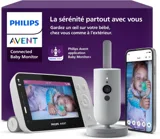
Baby sleeps, you breathe.
Which video baby monitor should you choose in 2026? Our criteria (with or without Wi-Fi, real-world range, battery life, night image, data security), how to set it up safely away from the cot, the settings that prevent false alarms, and our reference model, the Philips Avent SCD951/26: a video baby monitor that works straight out of the box, with an optional app.
- 1080pFull HD camera
- 120°Lens
- 400 mOutdoor range
- 12 hEco mode
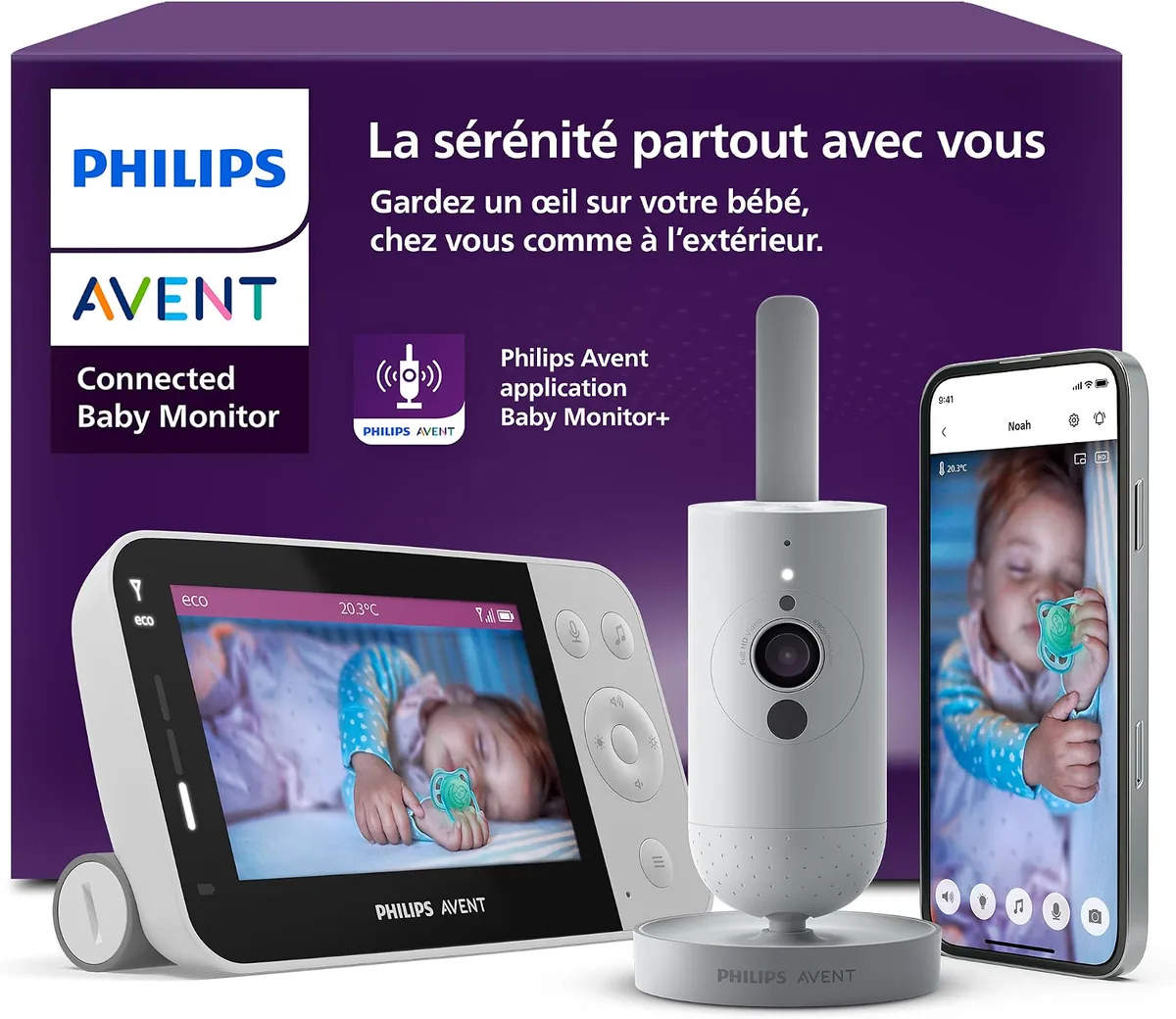
- Full HD camera
- Night vision
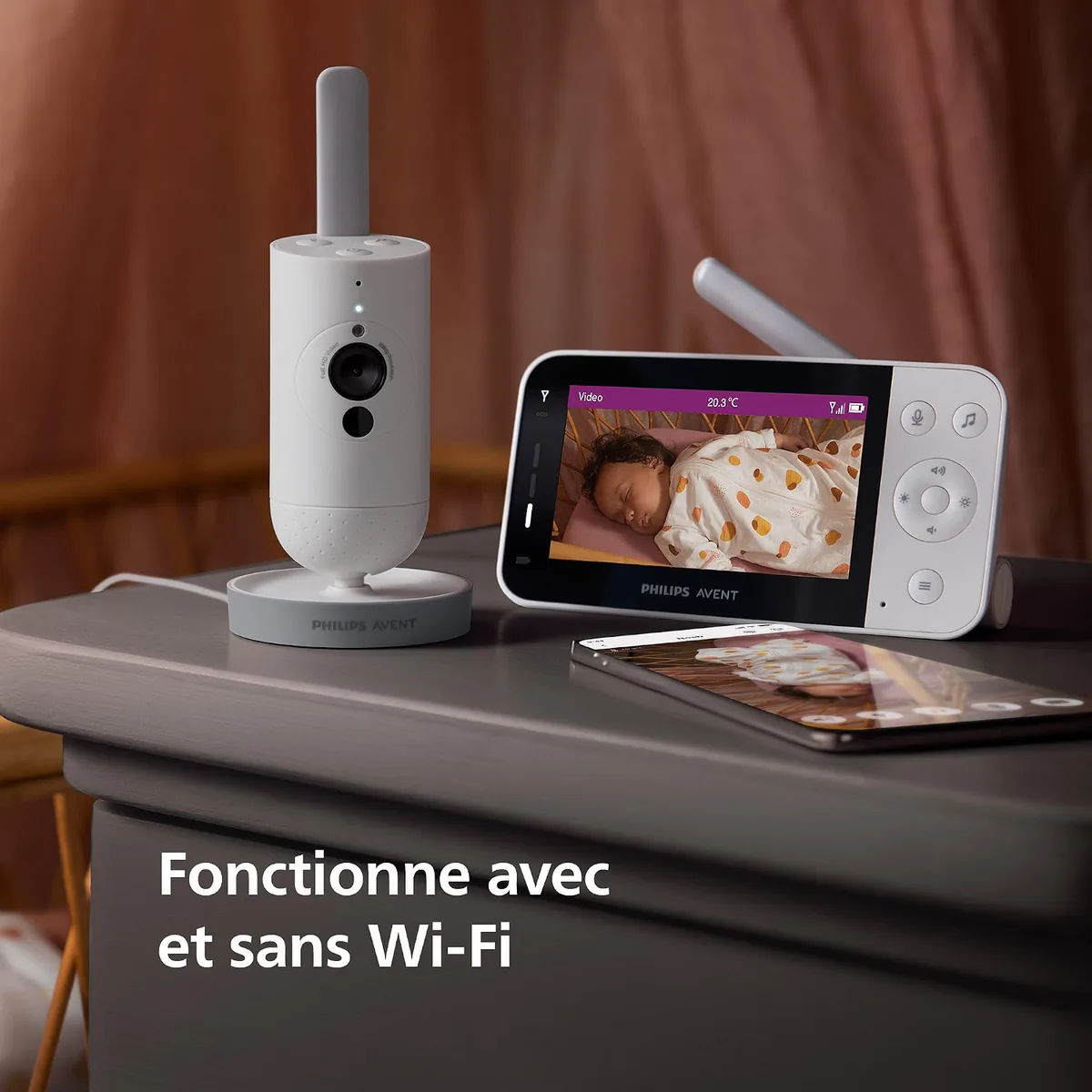
- With or without Wi-Fi
- Talk back
- Secure Connect
- 4.3-inch screen
- Room thermometer
- Night light
- 15 soothing sounds
- 12 h in Eco mode
See everything, hear everything, without opening the door.
What the Philips Avent SCD951/26 does well. Select a feature to see it in a picture.
- 1080pFull HD camera
- 120°Wide-angle lens
- 50 mStated indoor range
- 400 mStated outdoor range
- 12 hBattery life in Eco mode
- 15Soothing sounds
The SCD951 at a glance.
- 1080pFull HD camera, digital zoom
- 120°Wide-angle lens
- 4.3"Parent unit colour screen
- 50 m / 400 mIndoor / outdoor range
- 12 hBattery life in Eco mode
- 2.4 GHzFrequency band
These figures come from the Philips specification sheet. Ranges are maximums: walls, floors and other wireless devices reduce them, and the 12-hour battery life is stated in Eco mode after a full charge. Check your set-up with our set-up calculator.
By day and by night.
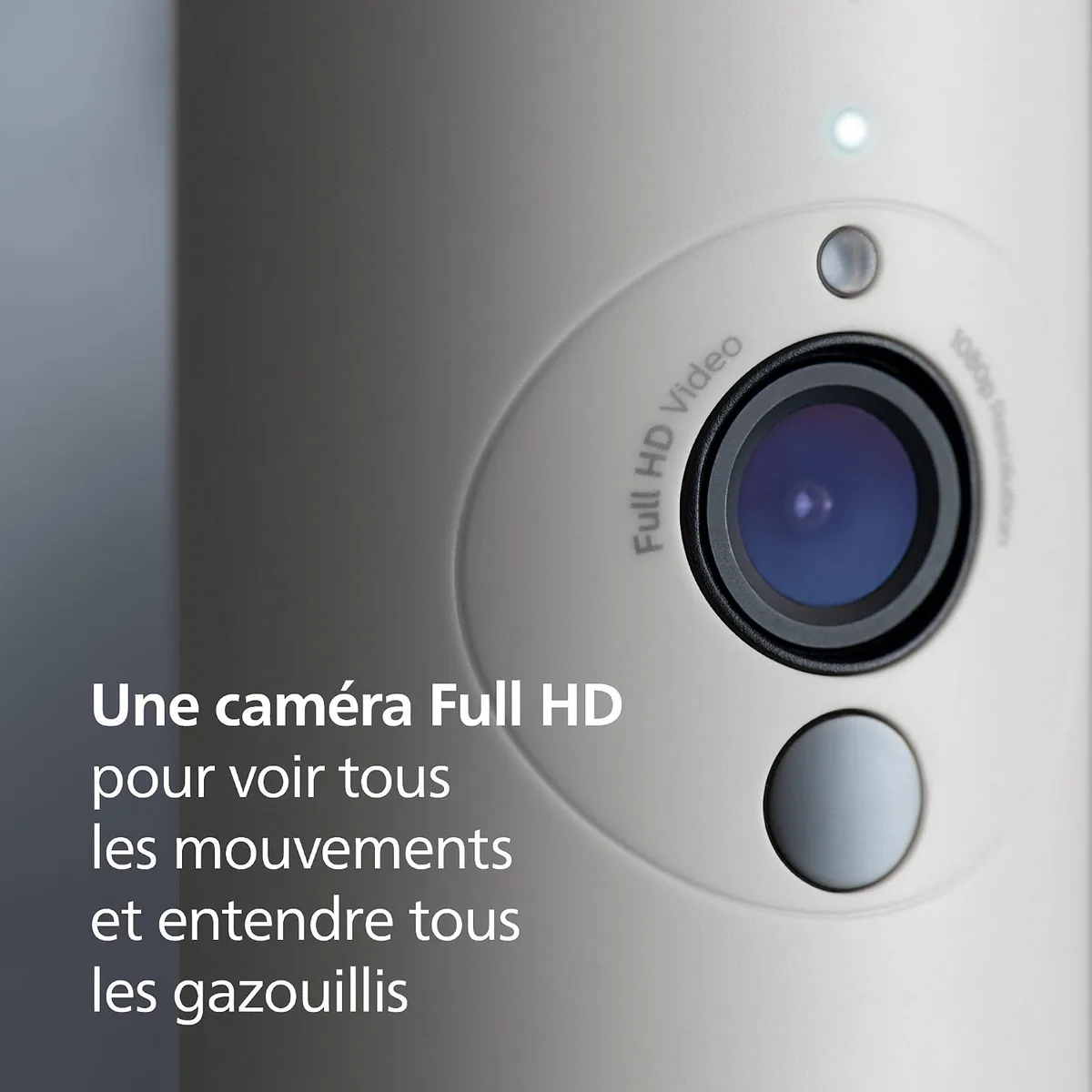
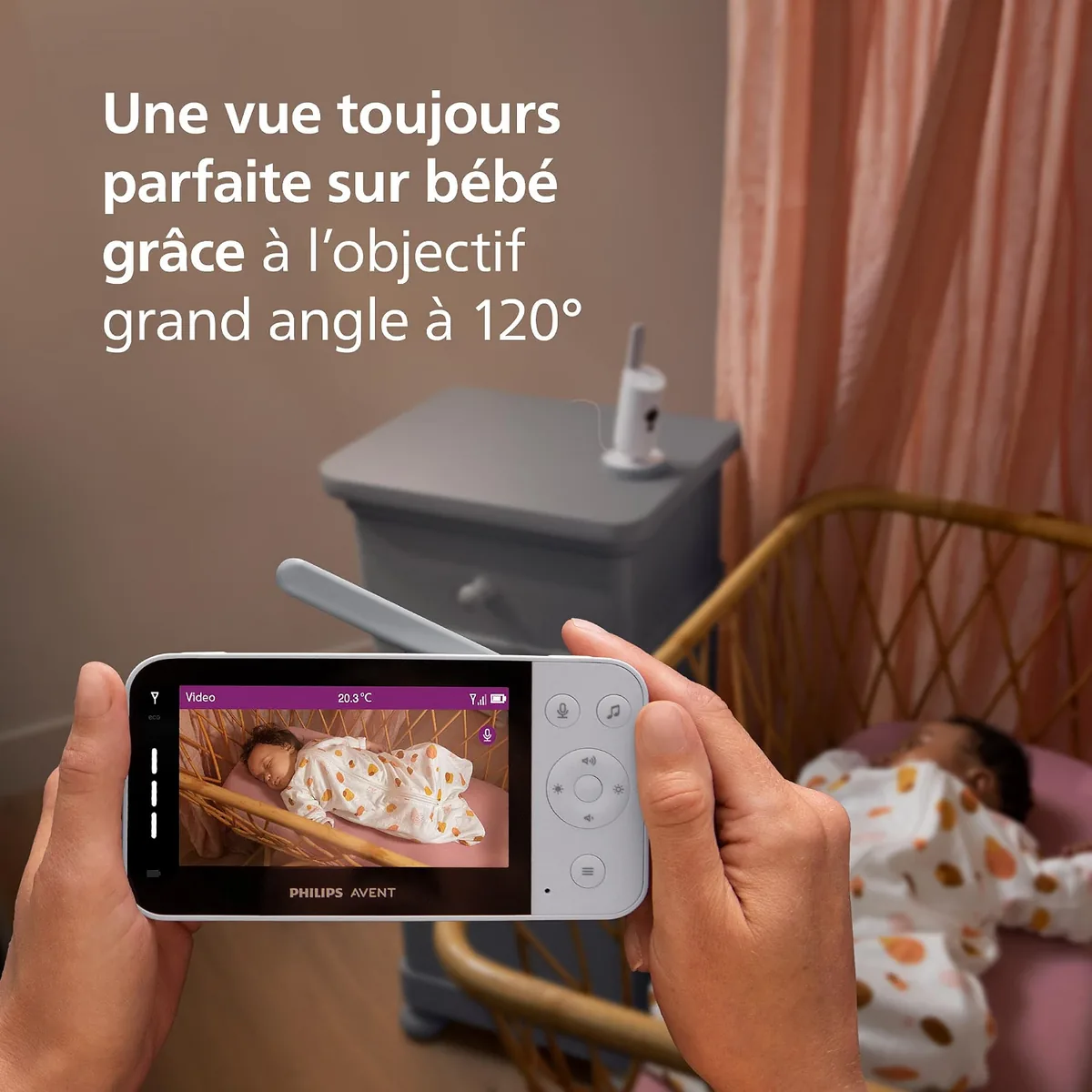
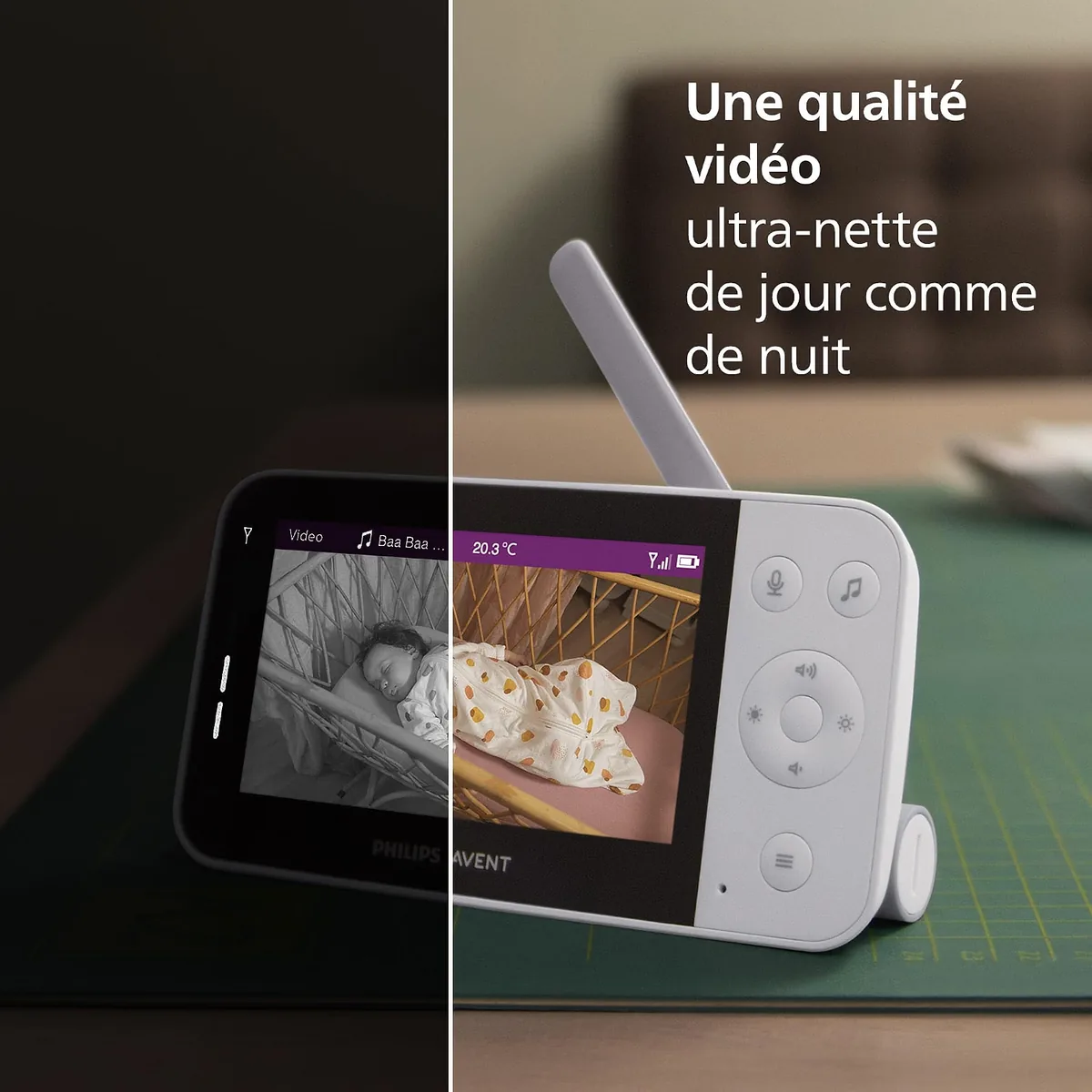
Full HD 1080p camera, digital zoom and 120° wide-angle lens: you see the whole cot and can zoom in on your baby’s face.
Philips data: Full HD 1080p camera, automatic night vision, digital zoom and pan.
Guide contents
Comparison: the right baby monitor for your situation
There is no such thing as the ideal baby monitor, only families who expect different things from one. Some live in a flat where the nursery is ten metres from the living room and simply want to see whether their baby is asleep during a nap. Others have a house on two floors and a garden, and want to keep the picture while they hang out the washing. Others still leave their baby with a childminder or the grandparents and would like a quick look from the office. Before comparing models, work out where you stand.
| Your situation | What you need | What to watch out for |
|---|---|---|
| Flat, nursery close to the living room | A video baby monitor with a direct link, Wi-Fi not required | A readable night picture and a camera set up more than one metre from the cot |
| House on several floors | A direct link with good indoor range | Floors and thick walls, which reduce the stated range |
| Garden, terrace, landing | A long outdoor range and a battery-powered parent unit | Real battery life, often stated in power-saving mode |
| Watching from work or elsewhere | A model with an app, over Wi-Fi or mobile data | The security of the account, the password and your router |
| No Wi-Fi, or no wish for a connected camera | A video baby monitor that works without an app | Checking that the app is optional, not essential |
The model we feature, the Philips Avent SCD951/26, ticks all five rows, because it combines a direct link between the camera and the screen, which works without a router, with an optional app for watching your baby from a distance. It is not the cheapest on the market, and we say so below. If you are torn between a connected model and one without Wi-Fi, our article Wi-Fi or non-Wi-Fi baby monitor explains the differences in detail.
What is a video baby monitor?
A baby monitor sends what is happening in your child’s room to a receiver that the parents keep with them. The first models only transmitted sound. A video baby monitor, or camera baby monitor, adds the picture: a baby unit with a camera and a microphone is placed or mounted in the room, and a parent unit with a screen and a speaker shows what the camera sees.
There are three main families. Direct-link video baby monitors connect the camera and the screen through a dedicated radio link, without going through your home internet router. Wi-Fi cameras have no dedicated screen: everything goes through an app on your phone, via your router and often via the manufacturer’s servers. Hybrid models, such as the SCD951/26, combine the two: a screen linked directly to the camera, plus an app if you want one.
They all have one thing in common: they are monitoring aids, not medical devices. They let you know that your baby is crying or moving; they do not monitor breathing and they replace neither a safe sleep set-up nor the presence of an adult. That is the key to this whole guide.
Our pick: the Philips Avent SCD951/26
The Philips Avent SCD951/26, sold as a connected baby monitor, pairs a baby unit fitted with a Full HD 1080p camera with a parent unit that has a 4.3-inch colour screen. The two come already paired: according to Philips, you plug in, switch on and the picture appears, with or without Wi-Fi. The camera has automatic night vision, digital zoom and pan, and a 120° wide-angle lens whose tilt you adjust by hand.
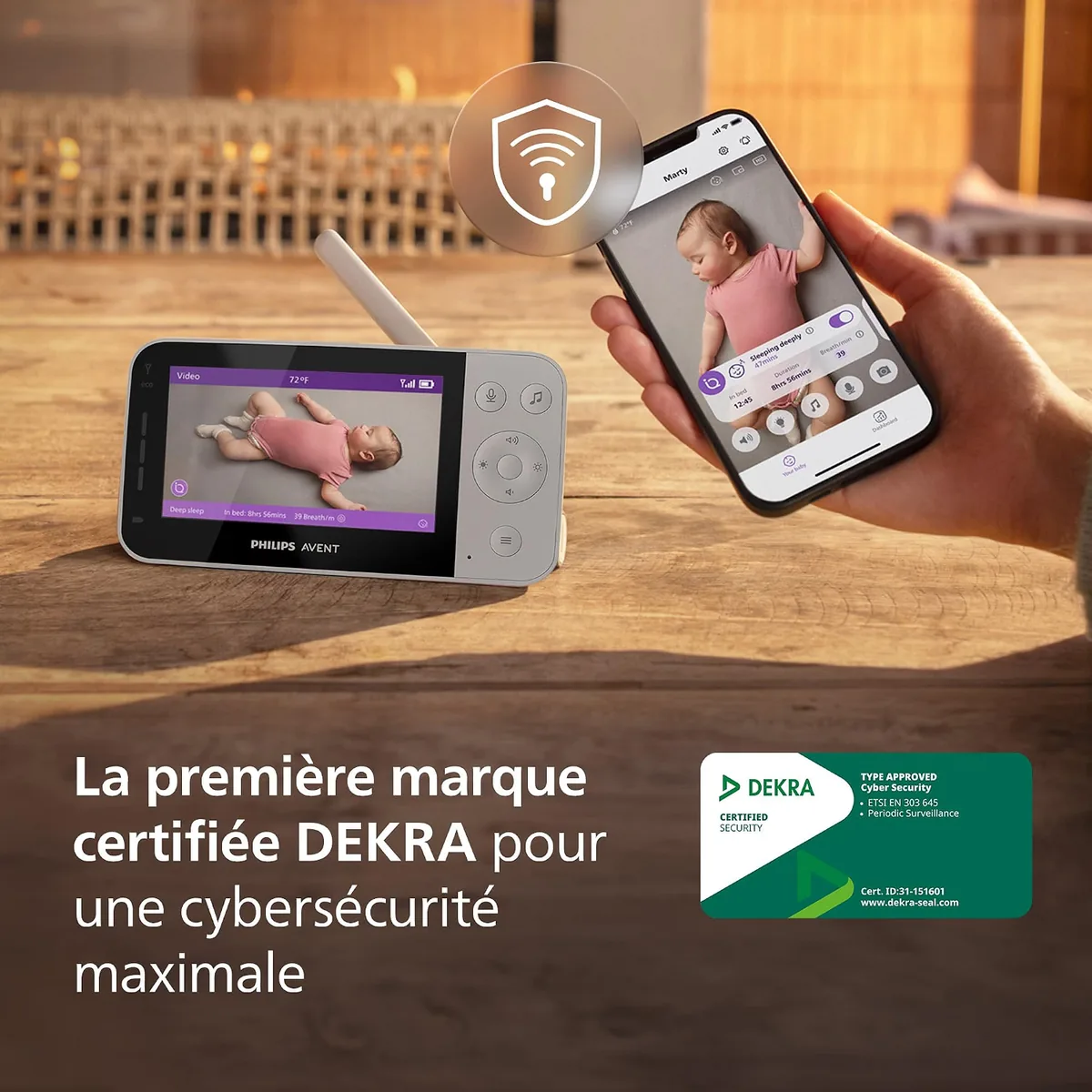
On the connection side, Philips states a direct peer-to-peer link between the camera and the screen on the 2.4 GHz band, with a range of up to 50 metres indoors and 400 metres outdoors. Its Secure Connect system relies, according to the brand, on several encrypted links between the camera, the parent unit and the Baby Monitor+ app, available on iOS and Android. The Philips support page states that the audio and video data transmitted are not stored on its servers.
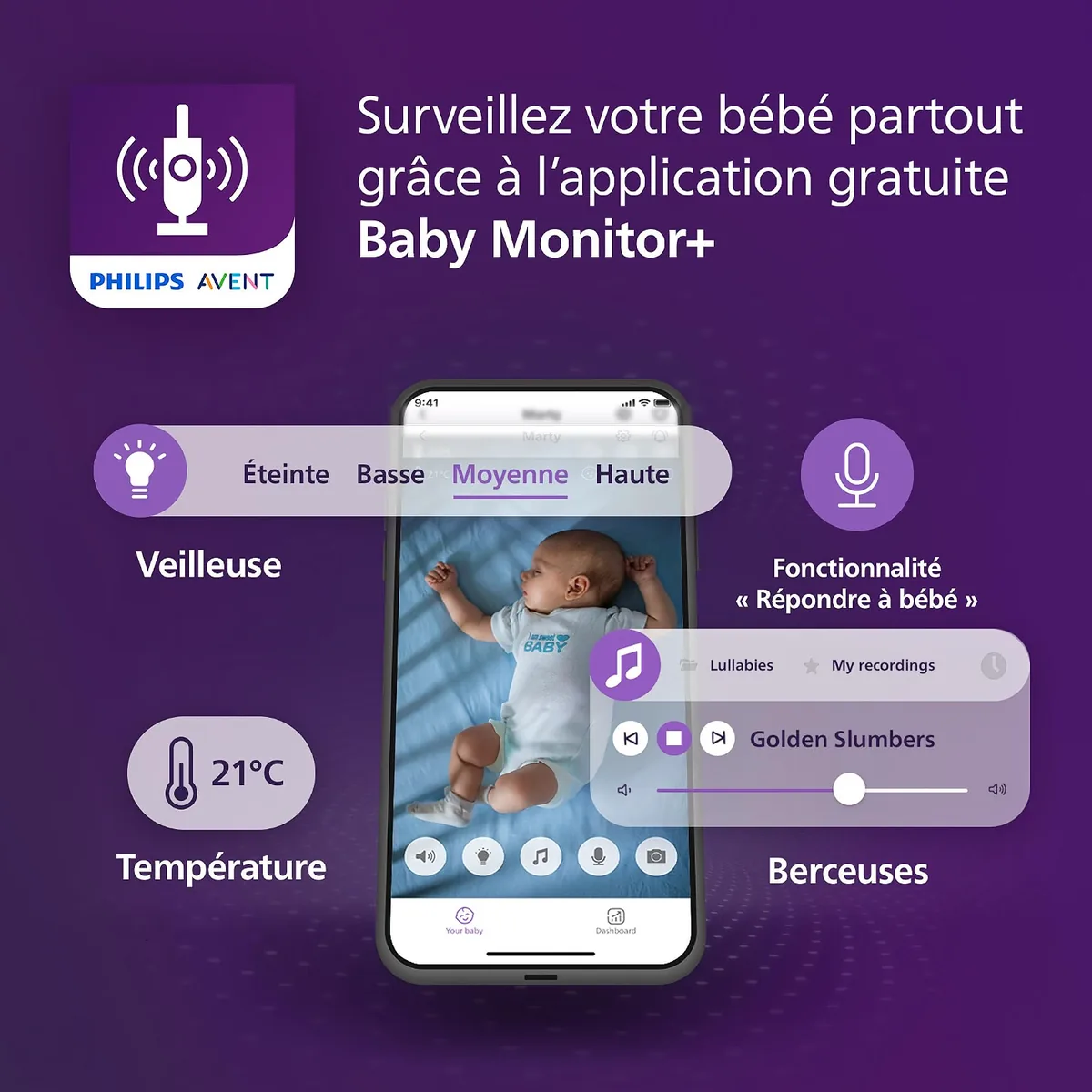
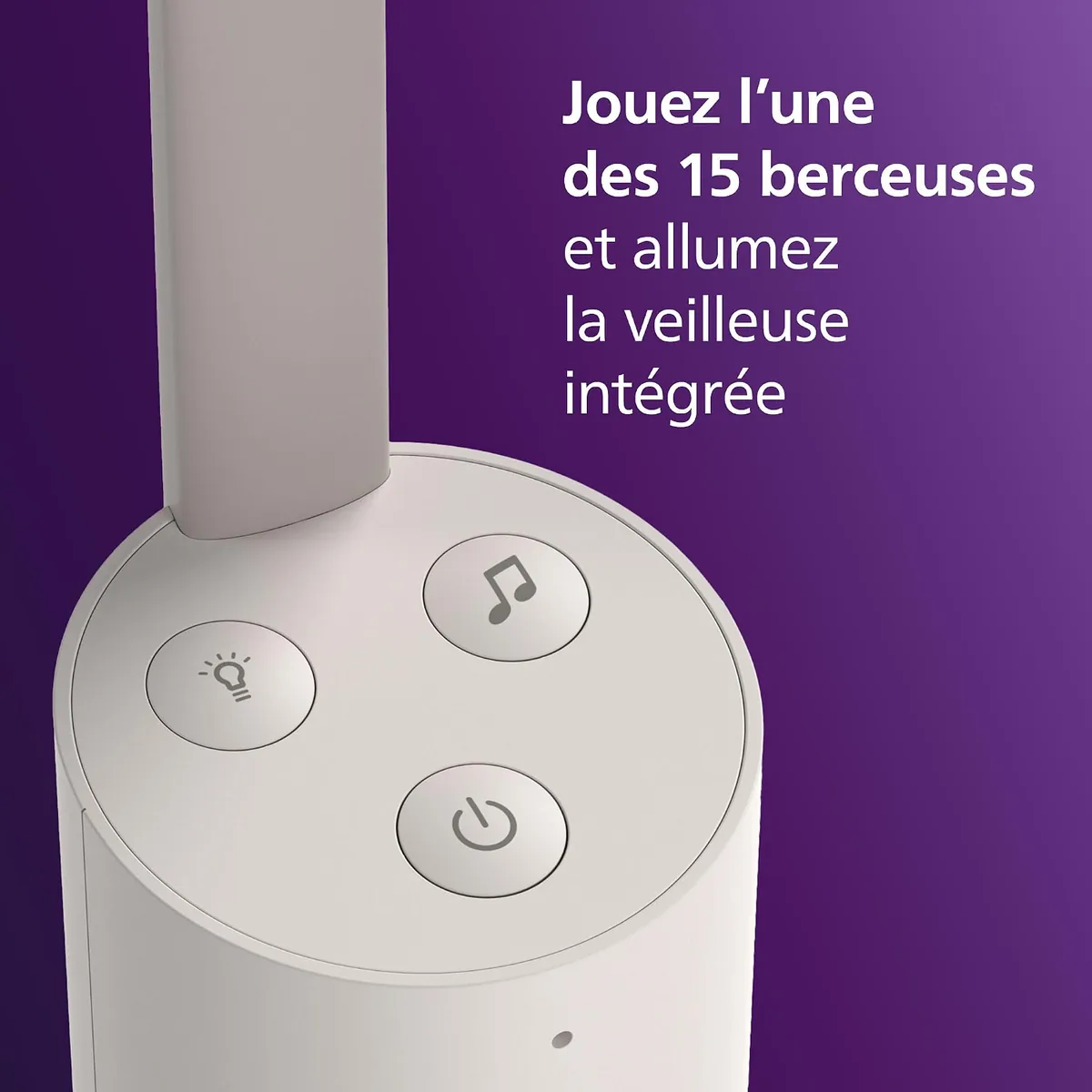
To soothe your baby without going in, the device offers “Talk back”, which lets you talk and listen at the same time, lullabies, soothing sounds and white noise with a timer, a night light and a room thermometer with an alert. The parent unit is rechargeable: Philips states 12 hours of battery life in Eco mode after a full charge. The baby unit runs on mains power only.
Its limitations are clear too. Its price is high, and that is the comment that comes up most often in published reviews. The camera is aimed by hand, with no motor. The 4.3-inch screen shows 480 x 272 pixels, which is enough for monitoring but far from the sharpness of the Full HD picture seen in the app. Our detailed review explains who it is for.
The one-metre rule around the cot
Before talking about picture, range or app, there is one rule that comes before all the others: the camera and its cable must stay at least one metre from any part of the cot. The US Consumer Product Safety Commission (CPSC) has recorded several deaths of infants strangled by the power cord of a baby monitor placed in the cot, on the cot rail or on a piece of furniture right next to it. It asks parents to keep baby monitors and their cords at least three feet, about 90 centimetres, from the cot, crib or playpen. We round this up to one metre, which is easier to remember.
In practice: never put the camera on the cot rail or hook it onto the bars, never let a cable hang down the wall above the mattress, never run an extension lead under the cot. The camera goes on the wall or on a chest of drawers well away from the cot, and the cable runs straight down to the socket, held against the wall with clips or a cable channel, out of the child’s reach. This rule still applies as your child grows, stands up and grabs anything within reach. Our guide to video baby monitor safety covers the set-up room by room.
Remember: the one-metre rule applies to the camera and to every cable, including those of a night light or thermometer if you add one. The 120° wide-angle lens of the SCD951/26 helps you follow it: you can see the whole cot from a chest of drawers or a wall some distance away.
What a baby monitor does not do
A baby monitor, even with video, even connected, does not protect your baby from sudden infant death. The American Academy of Pediatrics, in its 2022 recommendations on infant sleep, advises against commercial products that claim to reduce this risk, and does not recommend home cardiorespiratory monitors as a prevention strategy. What protects your baby is how they sleep: on their back, on a flat, firm mattress, with no pillow, blanket, cot bumper or soft toy, in a sleeping bag that fits their size.
France’s public health agency, Santé publique France, through its “first 1,000 days” website, also recommends putting your baby’s cot in the parents’ room for at least the first six months, and keeping the room between 18 and 20 °C, aired and smoke-free. The baby monitor fits around these rules: for daytime naps when you are in another room, for evenings when your baby goes to sleep before you, and then when your child moves into their own room. The thermometer built into the SCD951/26 helps you keep an eye on the room temperature; it does not replace checking for yourself.
A baby monitor can also give a false sense of security. You tell yourself that the device is keeping watch, when it only passes on what it picks up. Keep the right habits: put your baby down safely, go in to check, and treat the baby monitor as a relay, not as a guarantee.
10 criteria for a good video baby monitor
- The type of link: direct, Wi-Fi or hybrid, and what happens if your router goes down.
- The stated range, indoors and outdoors, and the number of walls and floors in your home.
- The parent unit’s battery life, and the mode in which it is measured.
- The night picture: automatic night vision and how readable it is in a dark room.
- The screen: size, resolution and adjustable brightness so it does not dazzle you at night.
- The sound: sensitivity setting, two-way talk, sound and visual alerts.
- Data security: encryption, protected account, updates, whether data is stored or not.
- Installation: wall mounting, field of view, cable length to stay well away from the cot.
- Soothing features: night light, lullabies, white noise, timer.
- What is in the box: power adapters, cables, mounts, instructions in your language.
Our guide on how to choose a video baby monitor goes through each criterion with the questions to ask yourself before you buy.
With or without Wi-Fi: three designs
A direct link is the simplest. The camera and the screen talk to each other by radio, with no router or server. If the internet goes down, the baby monitor keeps working. The range is limited to that of the radio link, and there is no access from outside the home.
A Wi-Fi-only camera goes through your router and, most of the time, through the manufacturer’s servers for remote access. You can watch your baby from anywhere, but it depends on the network: a router outage, a phone in battery-saving mode or a delayed notification can leave you without an alert. It also exposes the family more to privacy issues.
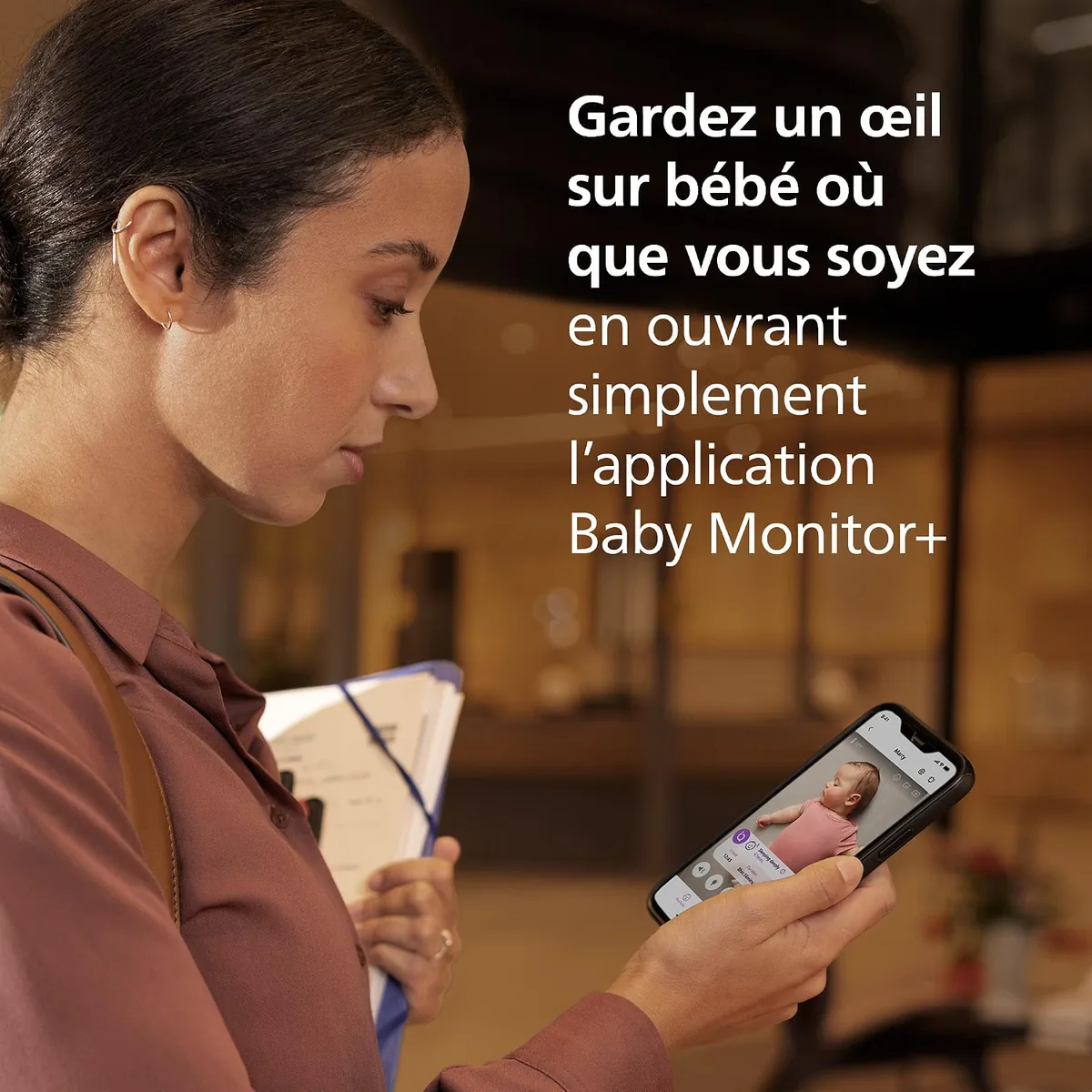
A hybrid model, such as the SCD951/26, aims for the best of both: the screen works over the direct link, and the app takes over when you are away. Philips says the app can also listen in the background, with the phone locked or while you use other apps. This is the design we recommend to most families: the essentials do not depend on the router, and remote access remains a bonus.
Range and battery life: reading the figures
The ranges stated by manufacturers are maximums measured in favourable conditions. Philips states up to 50 metres indoors and 400 metres outdoors for the SCD951/26. In your home, the range will depend on the thickness of the walls, concrete floors, metal furniture and other devices that use the 2.4 GHz band, such as a Wi-Fi router, a microwave or some smart devices. A stone house can cut a link well before the stated distance; a flat with light partition walls will be more favourable.
Battery life follows the same logic. The 12 hours stated for the parent unit apply in Eco mode, after a full charge, according to Philips. Screen on all the time, brightness at maximum, volume up: the battery will last less. For a full night, the safest option is to plug the parent unit in on your bedside table. Our article on baby monitor range and battery life explains how to test at home, and our calculator checks your set-up.
Day picture, night picture, screen
By day, a Full HD camera clearly shows your baby’s face and movements, especially in the app. At night, infrared night vision takes over: the picture turns black and white and stays readable in a dark room. On the SCD951/26, it switches on automatically, according to Philips. The digital zoom lets you frame your baby’s face from a camera placed well away from the cot, which helps you follow the one-metre rule.
The parent unit’s screen matters as much as the camera. The SCD951/26 screen measures 4.3 inches and shows 480 x 272 pixels: enough to see whether your baby is sleeping, moving or crying, but the picture is less sharp than in the app on a recent phone. Parents who want a very large screen will look at other models; those who mostly glance at the screen at night will be happy with it.
Privacy and hacking
A camera in a child’s room is a sensitive object. In 2022, the Belgian consumer association Test-Achats tested ten video baby monitors and found 55 potential security flaws, nine of them critical, noting that the big brands, Philips included, scored well with less serious flaws. The French data protection authority (CNIL) advises, for all connected devices, changing the default settings, protecting your phone and Wi-Fi network with a password and installing security updates regularly.
The first line of defence is the design: a direct-link baby monitor used without an app cannot be reached from the internet. If you use the app, choose a long, unique password for the account, keep the app and the baby monitor up to date, secure your router and avoid public Wi-Fi when watching your baby. Our article on baby monitor hacking gives the full procedure.
The question of radio waves
A baby monitor emits radio waves, like a router, a phone or wireless headphones. In France, the national health and safety agency Anses published an assessment in 2016 on children’s exposure to radiofrequencies and called for moderate, controlled use of wireless technology by children. It also recommended that products intended for children meet the same testing and information requirements as mobile phones.
For a baby monitor, common sense matches the safety rule: placing the camera away from the cot reduces exposure, because the field strength drops quickly with distance. You can also avoid putting the parent unit against your own pillow and switch the camera off when it is not in use. Our article on baby monitors and radio waves sums it up without alarmism.
Where to put the camera
The right spot meets three conditions: more than one metre from any part of the cot, a clear view of the mattress and a socket nearby so that the cable does not cross the room. Wall mounting, up high, at the head or foot of the cot, is often the best solution; the SCD951/26 can be wall-mounted, according to Philips. A chest of drawers some distance away also works, as long as no child can climb onto it or pull the cable.
Avoid placing the camera facing a window, which dazzles the picture by day, or too close to a bright night light, which interferes with night vision. Tilt the lens to see the whole mattress, then check from the parent unit that the picture is stable and the sound comes through. Our user guide and our article on setting up and adjusting a baby monitor go through each step.
Check the price on AmazonPhilips Avent SCD951/26 baby monitor · new tabSensitivity, alerts and false alarms
A badly adjusted baby monitor is soon forgotten, or wakes the whole house. Microphone sensitivity decides the sound level at which the screen lights up: too high and it triggers alerts at the slightest sigh; too low and it misses quiet crying. Start in the middle, then adjust over a few nights. The SCD951/26 offers sound, motion, temperature, low battery and connection lost alerts, according to the Philips sheet.
The connection lost alert is the most important: it tells you that you are no longer receiving anything. Do not switch it off. Set the others according to your home and how you sleep. The audio-only mode provided by Philips lets you keep the sound with the screen off, which saves battery and keeps light out of your bedroom.
From when, and until when?
A baby monitor can be used from the day you come home from hospital, for daytime naps. During the first six months, your baby ideally sleeps in the parents’ room at night: the baby monitor is then mostly used during the day and in the evening. It really comes into its own when your child moves into their own room. Many families keep it until two or three years old, sometimes longer, especially in a large house or for nights when the child is ill. There is no official age to stop: our article baby monitor: up to what age? gives some pointers.
Mistakes to avoid
- Putting the camera on the cot rail or hooking it onto the bars.
- Letting a cable hang above the mattress or run under the cot.
- Believing that the baby monitor checks breathing or prevents sudden infant death.
- Keeping the default password or one already used elsewhere.
- Watching your baby over public Wi-Fi in a café or station.
- Trusting the stated range without testing it in your home.
- Relying on the battery for the whole night instead of plugging in the parent unit.
- Switching off the connection lost alert because it sometimes goes off.
Who it is for, and who it is not for
The SCD951/26 suits:
- people who want a video baby monitor that works straight out of the box, with no router to configure;
- families who would like to watch their baby from a distance now and then, without relying on the app every night;
- homes with a garden or terrace, thanks to a long stated outdoor range;
- people who want a manufacturer that is open about encryption and data protection.
It suits less:
- people who want a motorised camera that pans from the screen;
- people looking for breathing or sleep tracking, which this model does not offer;
- tight budgets, for whom an audio baby monitor or a simpler video model will do.
Baby monitor, thermometer, night light: who does what
Many devices now promise to watch over your baby’s sleep. An audio baby monitor transmits sound: light, simple and often with long battery life, it is enough for many families in a small home. A video baby monitor adds the picture, useful for knowing whether a cry really means you need to get up, and for checking at a glance that your baby is asleep. A room thermometer, often built in, helps keep the room between 18 and 20 °C. A night light reassures some children, as long as the light is soft and disturbs neither sleep nor the camera’s night vision.
Breathing or sleep monitors, with a sensor under the mattress, a camera that analyses movement or a device worn by the baby, form another category. The American Academy of Pediatrics advises against presenting or using them as a way to reduce the risk of sudden infant death. If your child has a particular medical need, it is up to the doctor to prescribe a suitable device. The SCD951/26 is not one of them: it is a video baby monitor, and Philips does not present it as a medical device.
The checklist before you buy
- I know where the camera will go, more than one metre from the cot, and where the nearest socket is.
- I know the distance and the number of walls between the nursery and the rooms where I will be.
- I know whether I want to watch my baby away from home, or only indoors.
- The baby monitor works without Wi-Fi, or I accept that it depends on my router.
- The stated battery life specifies the measurement mode, and I plan to plug in the parent unit at night.
- The manufacturer describes encryption, account management and updates.
- The instructions are in my language, and the box contains the power adapters needed.
- I have checked the exact model number and the seller.
Buying on Amazon: what to check
Philips offers its connected baby monitor in several closely related versions (SCD921, SCD923, SCD951, SCD953) and also sells a camera on its own and a premium monitor with sleep tracking. Before ordering, check the exact model number (SCD951/26 for the model presented here), the seller, whether instructions in your language are included and what is in the box. The stated contents for the SCD951/26 are a parent unit, a baby unit, a power supply with adapter, a USB-C to USB-A cable and access to the Baby Monitor+ app. One published review points out that you need your own USB charger for the parent unit. The price changes often: we do not display it and point you to the current offer.
Keep your proof of purchase: you will need it for the statutory guarantee with the seller and for any request to the manufacturer.
How we write our guides
We are not a test laboratory and we did not receive the SCD951/26 from the brand. Our information comes from the Philips specification sheet and support pages, retailers’ listings, the recommendations of the CPSC, the American Academy of Pediatrics, Santé publique France, Anses and the CNIL, and the Test-Achats security test. When we summarise parents’ feedback, we describe trends, without naming anyone or copying reviews. Our rating is an editorial assessment, not a customer review. Everything is explained on our affiliate disclosure page.
Frequently asked questions
What is the best video baby monitor?
The one that suits your home and how you will use it. For a video baby monitor that works without Wi-Fi while offering an optional app, the Philips Avent SCD951/26 is our pick, for its direct link, its Full HD camera and its stated encrypted connections.
Does a video baby monitor work without Wi-Fi?
Direct-link and hybrid models, such as the SCD951/26, do. Wi-Fi cameras with no dedicated screen do not: they depend on your router and the app.
How far from the cot should the camera be?
At least one metre from any part of the cot, cable included. The CPSC asks for at least three feet, about 90 centimetres, after several deaths by strangulation.
Does a baby monitor protect against sudden infant death?
No. What protects your baby is safe sleep: on their back, on a flat surface, in their own cot, with nothing around them, in a room at 18 to 20 °C.
What is the range of the Philips Avent SCD951/26?
Up to 50 metres indoors and 400 metres outdoors according to Philips, and no distance limit with the app and an internet connection.
What is its battery life?
Philips states 12 hours for the parent unit, in Eco mode, after a full charge. The baby unit runs on mains power.
Can a video baby monitor be hacked?
A device connected to the internet can be if it is poorly protected. A strong password, updates, a secure router and no public Wi-Fi greatly reduce the risk. A direct-link model used without the app cannot be reached from the internet.
Are baby monitor radio waves dangerous?
Anses calls for moderate use of wireless technology by children. Placing the camera away from the cot, as cable safety requires, also reduces exposure.
Naps, nights, the office.
The moments when a video baby monitor really helps, and what it will never do for you.
Technical specifications.
- ConnectionDirect (peer-to-peer) and Wi-Fi, 2.4 GHz band
- Stated rangeUp to 50 m indoors and 400 m outdoors; unlimited via the app with internet
- CameraFull HD 1080p, automatic night vision, digital zoom and pan, 120° lens
- Parent unit4.3-inch colour LCD screen (480 x 272), battery and mains
- Battery life12 hours in Eco mode after a full charge
- Baby unitMains power only, wall mounting possible
- FeaturesTalk back, soothing sounds and white noise with timer, night light, room thermometer
- AlertsLow battery, connection lost, temperature, sound, motion
- AppBaby Monitor+, iOS 11 and Android 6 or later
Philips data (SCD951/26 sheet). Details and sources in our full specifications.
Philips Avent SCD951/26 video baby monitor
- Day and night picture★★★★★
- Ease of set-up★★★★★
- Security and privacy★★★★★
- Range and battery life★★★★★
- Soothing features★★★★★
- Value for money★★★★★
The Philips Avent SCD951/26 is aimed at parents who want a video baby monitor that is easy to set up, usable without Wi-Fi, with the option to watch their baby remotely when they need to.
It suits less those who want a motorised camera, breathing monitoring or a bigger screen. Our detailed review explains who it is for, and who it is not for.
Why it is our top pick
- A direct link between the camera and the parent unit: the monitor works straight out of the box, even without a home internet connection.
- A Full HD camera with automatic night vision, digital zoom and a 120° wide-angle lens.
- Encrypted connections announced by Philips (Secure Connect), and a manufacturer that states it does not store audio or video on its servers.
- An optional app to watch your baby from work or when you are out, over Wi-Fi or mobile data.
- The “Talk back” function to talk and listen at the same time, plus soothing sounds and a night light.
- A room thermometer with alert, useful for keeping the room between 18 and 20 °C.
Limitations
- A high price: it is the criticism that comes up most often in published reviews.
- A camera you can only aim by hand: no motorised rotation from the screen or the app.
- A 4.3-inch 480 x 272 screen: fine for monitoring, less sharp than the Full HD camera picture seen in the app.
- A baby unit that runs on mains power only: you need a socket well away from the cot and a tidy cable.
Our guides to go further.
Choosing, setting up, staying safe: our in-depth articles.
Is your set-up ready?
A quick check against the ranges stated by Philips: up to 50 m indoors, 400 m outdoors.
Direct link with or without Wi-Fi, Full HD camera, night vision, Talk back and an optional app: a video baby monitor that is easy to set up.
- Full HD
- 50 m / 400 m
- 12 h Eco
An eye on your baby, anywhere.
Full HD camera · Night vision · With or without Wi-Fi · Talk back · 12 h in Eco mode. The price changes often on Amazon: check it, along with the seller, the exact model number (SCD951/26) and what is in the box, before you order.
Check the price on AmazonAffiliate link · new tab