Video baby monitors and your baby’s safety: the complete guide
A baby monitor is reassuring, and it can also carry risks when it is badly placed or badly configured. The first comes down to one word: the cable. The others concern sleep, the room and your family’s data. Here is what health and safety authorities say, and how to apply it at home.
Contents
The essentials in one minute
The camera and its cable must stay at least one metre from any part of the cot, out of reach of a child standing up, never placed on the cot, on its rail or on furniture right next to it. A baby monitor replaces neither safe sleep (on the back, on a flat surface, in their own cot, with nothing around them) nor your presence. It is not a medical device. The room stays between 18 and 20 °C. For a connected model, a strong password and updates protect your family’s images. As for radio waves, distance is enough to limit exposure. Each stage of your child’s development calls for a new check.
Risk number one: the cable
The US Consumer Product Safety Commission (CPSC) has been warning for several years about a specific risk: children being strangled by a baby monitor cable. It has recorded deaths of infants and young children that happened because a baby monitor cord was within reach, in the cot, on its rail or right next to it. It mentions in particular the case of a 20-month-old found with a camera cord around his neck.
These tragedies have a common cause: the cable was hanging, trailing or running within reach. A baby who rolls over, stands up, reaches over the bars or slips a hand between them can grab a cable that was thought to be out of reach. That is why the CPSC asks parents to keep baby monitors and cords at least three feet from the cot, about 90 centimetres, which we round up to one metre.
This risk does not depend on the brand or price of the baby monitor. It depends only on where it is placed. It is entirely avoidable.
The one-metre rule in practice
One metre means one metre between the camera and any part of the cot: bars, rail, headboard, legs. It also applies to the cable along its whole length, up to the socket. Measure it once with a tape measure rather than estimating by eye: it is easy to underestimate distances in a small room.
- The camera is mounted on the wall or placed on furniture more than one metre from the cot.
- The cable runs straight down to the socket, fixed flat to the wall, with no loop.
- The socket used is not behind the cot.
- No excess cable is lying on the floor near the cot.
- Nothing is within reach of a standing child with an outstretched arm.
If the only socket in the room is behind the cot, move the cot. An extension lead running along the opposite wall is better than a cable passing near the mattress. Our guide on setting up and adjusting a video baby monitor details mounting and cable tidying.
Risky situations
The camera on the cot rail
This is the most dangerous situation, and one of the most common: the rail seems the ideal place to see your baby well. The cable then hangs right next to them. Do not do it.
The camera clipped to the bars
Some cameras attach with an arm or a clamp. If it is attached to the cot, its cable is necessarily within reach. Mount the camera on the wall instead.
Furniture right next to the cot
A chest of drawers or bedside table pushed against the cot is within reach of a standing child. So is the cable that runs down from it.
The cable running behind the cot
A cable slipped between the cot and the wall remains reachable: the child slides a hand between the bars, or the cot moves away from the wall.
Playpens and travel cots
The rule applies wherever your baby sleeps: playpen, travel cot, holiday cot, at the grandparents’.
As your child grows
What was out of reach at three months is no longer so at one year. Check the set-up again at each stage: when your baby rolls over on their own, sits up, stands up holding the bars, starts climbing, moves to a big bed. A child who walks can also reach a socket, pull a cable or climb onto low furniture to grab the camera.
At each stage, repeat the outstretched arm test: get down to your child’s height, standing in the cot or on the floor, and check that nothing is within reach. Our article baby monitor: up to what age? goes with these changes.
A baby monitor does not replace safe sleep
France’s public health agency, Santé publique France, sets out the sleep rules that protect your baby: put them down on their back, on a flat surface, in their own cot, on a firm, suitable mattress, with no pillow, blanket, duvet, cot bumper or soft toy, in a sleeping bag that fits their size. For at least the first six months, it advises having your baby sleep in the parents’ room, in their own cot.
A baby monitor replaces none of these rules. It passes on what it picks up and lets you react faster, but the essential protection remains how your baby sleeps. A baby monitor must never become a reason to relax any of these rules.
A baby monitor is not a medical device
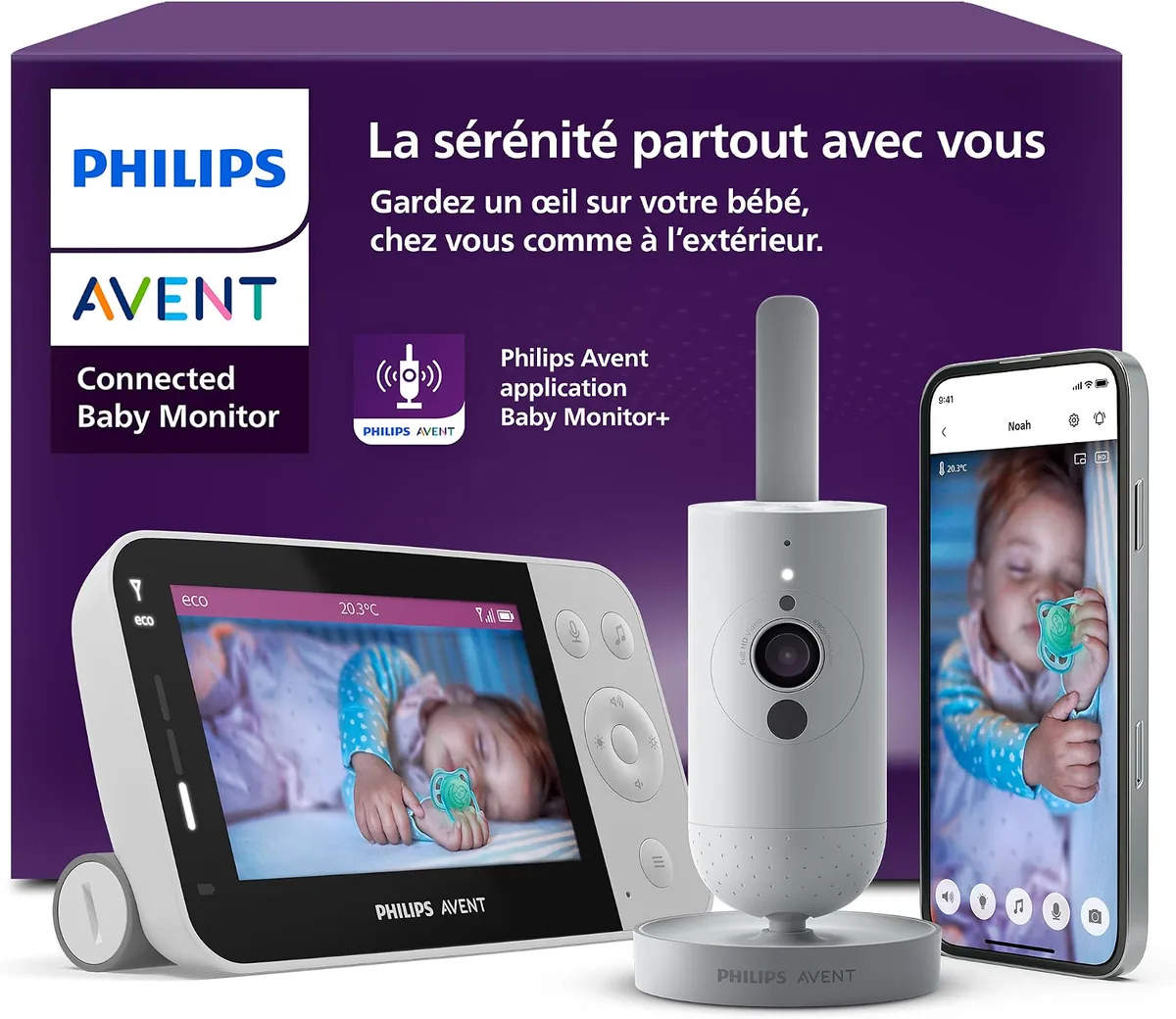
Consumer video baby monitors, such as the Philips Avent SCD951/26, transmit picture and sound, and sometimes temperature or motion alerts. They do not measure breathing or heart rate, and are not designed to prevent sudden infant death.
The American Academy of Pediatrics (AAP), in its 2022 recommendations, advises avoiding commercial devices that claim to reduce the risk of sudden infant death, and does not recommend home cardiorespiratory monitors as a prevention strategy. If your child has a particular health problem, your paediatrician will tell you whether medical monitoring is needed, and which kind.
Room temperature
Santé publique France recommends a room between 18 and 20 °C, aired every day, smoke-free. A room that is too warm is a risk factor during sleep. Many baby monitors have a built-in thermometer: the one on the SCD951/26 shows the temperature and can trigger an alert, according to Philips.
Set the alert around the recommended range. Remember that the thermometer measures the temperature where the camera is, up high, sometimes near a window or radiator: check from time to time with a thermometer placed near the cot. Dress your baby for the real temperature, without a blanket, in a sleeping bag suited to the season.
A safe room around the baby monitor
The baby monitor is part of a whole. Use its installation to check the rest of the room: blind and curtain cords tied up high, out of reach, as safety authorities recommend; furniture fixed to the wall so it cannot tip over; covered sockets; no small objects within reach of the cot; night light and lamps away from the cot, cables included.
Blind cords carry a strangulation risk very similar to that of baby monitor cables. The outstretched arm test applies to them too.
Electrical and battery safety
Use the adapter supplied or one that matches the instructions: Philips specifies a 5 V, 1 A adapter for the SCD951/26. Do not keep a damaged cable in use: an exposed wire, a split sheath or a plug that gets hot means the part must be replaced. Avoid overloaded multi-socket adapters near the cot.
The parent unit is charged on a hard surface, not on a bed or a cushion. If its battery swells, gets unusually hot or runs down suddenly, stop using it and contact the manufacturer. Keep small parts and packaging out of children’s reach.
Protecting your family’s data
A connected baby monitor sends images of your child’s room over the internet. In 2022, the Belgian consumer association Test-Achats analysed the security of ten video baby monitors and found 55 flaws, 9 of them critical, with big differences between models: the big brands, including Philips with its SCD923/26, did better. This is not the SCD951/26, but it shows that security varies a lot from one device to another.
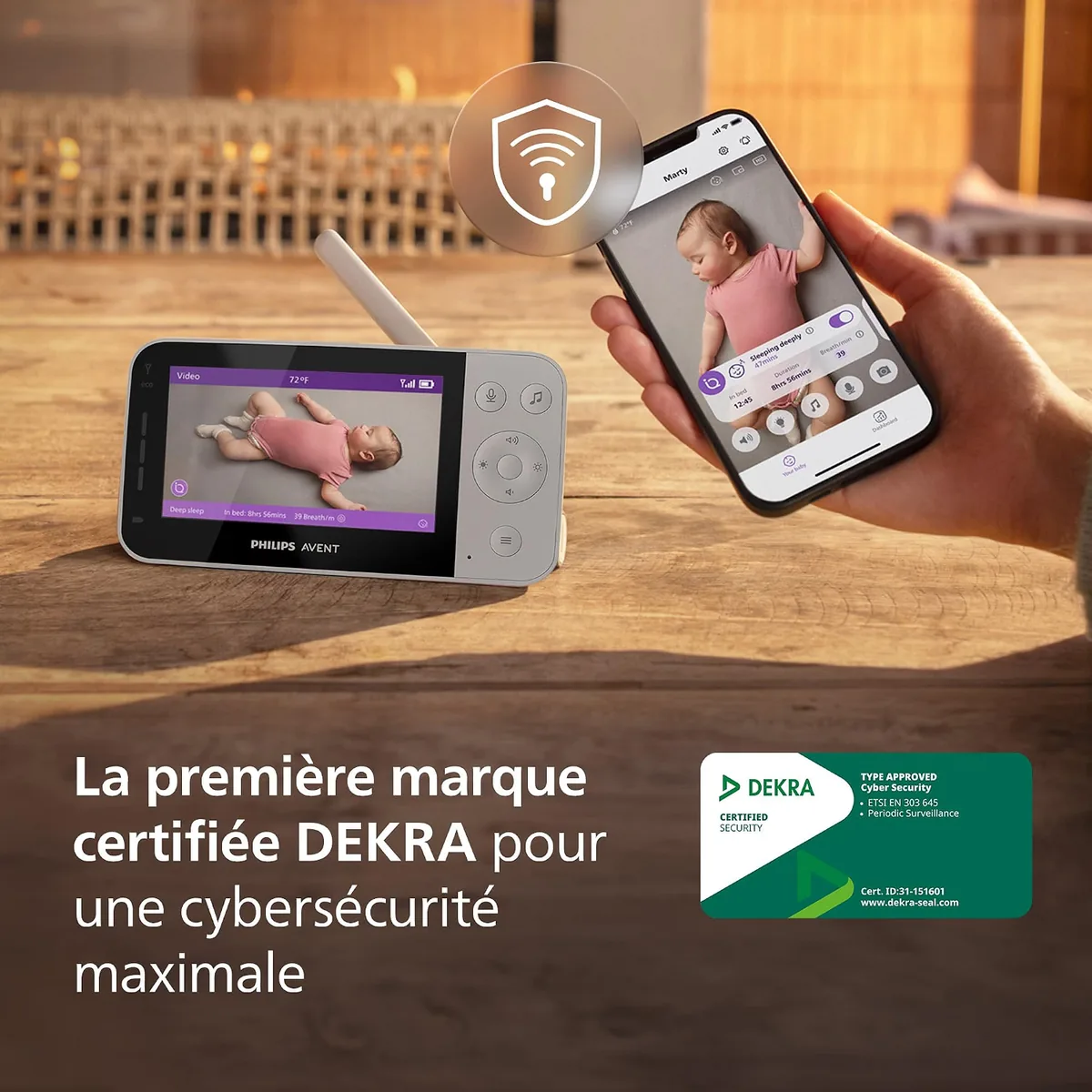
The basic habits are simple: a long, unique password, updates for the baby monitor and the app, a secure router, no public Wi-Fi, limited and controlled shared access. The French data protection authority (CNIL) recommends changing the default settings of connected devices and keeping them up to date. Philips states that audio and video from its connected baby monitors are not stored on its servers. Our guide to baby monitor hacking details each habit.
What about radio waves?
Baby monitors emit radio waves to communicate. The French health and safety agency Anses, in its 2016 report on children’s exposure to radiofrequencies, recommends moderate, controlled use of wireless technology by children, and stresses that distance greatly reduces exposure. The one-metre rule, designed for the cable, also keeps the transmitter away from the cot.
Devices sold in Europe must comply with Directive 2014/53/EU on radio equipment. Keep the parent unit away from your own pillow, switch the baby monitor off when it is not in use, and deactivate the app if you do not need it. Our article on baby monitors and radio waves sums it up without alarmism.
Good everyday habits
- Switch on the baby monitor and check the link before leaving the room.
- Always keep the connection lost alert on.
- Plug in the parent unit at night.
- Go and see your baby when something worries you, even if the picture looks normal.
- Never leave a child alone at home, even asleep, even with an app.
- Check the cables and the camera mounting once a month.
When someone else looks after your baby
Grandparent, nanny, babysitter: show the person looking after your child how the baby monitor works, where the camera is and why it must never be moved closer to the cot. Explain the connection lost alert and what to do. Remind them of the safe sleep rules, which come before everything else.
If you watch the camera remotely, tell the person looking after your baby. In France, the CNIL points out that an employee working in a private home must be informed of a camera and cannot be filmed constantly; check the rules that apply where you live. Our article on watching your baby remotely with the app covers this point.
On holiday and at the grandparents’
Away from home, the one-metre rule stays the same, but the set-up is often improvised: an unfamiliar room, a badly placed socket, a travel cot in the middle of the room, different furniture. That is precisely where mistakes happen. Take five minutes when you arrive to find a safe spot, even if it means moving the travel cot or placing the camera on a closed suitcase on the floor a good distance away.
If you can, bring a few adhesive clips to fix the cable to the wall, and check the range in the accommodation: a stone wall in a country house or a room on another floor can cut the link. At the grandparents’, show them the set-up before you leave, and remind them that the camera never moves closer to the cot, even to see better.
A second-hand or borrowed baby monitor
A second-hand baby monitor can be useful. Check that it is complete, with its original adapter or one matching the instructions, that the cables are intact and that the parent unit’s battery still holds a charge. For a connected model, reset it to factory settings, create your own account, change the password and install updates before first use. Make sure the previous owner no longer has access to the camera.
Conversely, if you sell or give away your baby monitor, delete your account, remove shared access and reset the device. Philips states that deleting the administrator account disconnects all guest users.
Common misconceptions
“With a baby monitor, I can let them sleep without checking the cot”
The baby monitor does not see a misplaced pillow or a blanket pulled up. Safe sleep is checked at bedtime.
“The cable is short, there is no risk”
A short cable on the cot rail is still within reach. It is the position that counts, not the length.
“A baby monitor that detects movement prevents sudden infant death”
No. The AAP advises against relying on consumer devices for this.
“My baby monitor is not connected, so it cannot be hacked”
A direct-link model without an app is much less exposed. A hybrid model with the app activated must be protected like any connected device.
The checklist
- Camera more than one metre from any part of the cot, playpen or crib.
- Cable fixed flat to the wall, with no loop, out of reach.
- Safe sleep: on the back, flat, nothing in the cot, sleeping bag.
- Room between 18 and 20 °C, aired, smoke-free.
- Connection lost alert on.
- Strong password and updates if the app is activated.
- A new check at each stage of your child’s development.
Safety criteria when buying
Safety starts before installation, as soon as you choose the device. A few simple criteria help you choose a safer baby monitor. A wide-angle lens and a zoom let you see well from more than one metre away: without them, you are tempted to move the camera closer. A wall mount, supplied or provided for, makes an out-of-reach position easier. A connection lost alert and a low battery alert stop you wrongly believing that all is well. A thermometer with an alert helps keep the room in the right range.
For a connected model, look at who makes it, whether they publish updates, whether they document their security and whether the app remains optional. Choose an identifiable seller, instructions in your language and a European declaration of conformity. Our guide on how to choose a video baby monitor covers all these criteria.
A typical night, safely
Here is what a well-prepared night looks like when your child sleeps in their own room. At bedtime, you check the cot: firm mattress, fitted sheet pulled tight, no pillow, no blanket, no soft toy, baby on their back in a suitable sleeping bag. You glance at the thermometer: between 18 and 20 °C. You switch the camera on if it was off, and check on the parent unit that the picture is sharp and the link is good.
In your bedroom, the parent unit is plugged in on the bedside table, brightness at minimum or in audio-only mode. During the night, the screen lights up when your baby makes a sound. You look, you listen, and you get up if something worries you or your baby needs you. If the connection lost alert goes off, you go and check. In the morning, you switch it off or leave it on standby depending on how your day is organised.
None of this is complicated. It is regularity that protects: the same steps every evening, without exception, even when you are tired.
When your baby is ill
A cold, a fever or a stomach bug make nights more restless, and you tend to want to monitor more closely. The baby monitor helps you hear a cough or crying sooner: you can turn the sensitivity up a little for those few nights, then go back to your usual setting. Never use this as an opportunity to move the camera closer to the cot.
Keep in mind that the baby monitor measures neither fever nor breathing. If your child worries you, go and see them, and call your doctor, or the emergency services in an emergency. The baby monitor’s thermometer gives the room temperature, not your baby’s.
Being ready for an emergency
No baby monitor will ever replace an adult who knows what to do. Many parents find it reassuring to take a baby and child first aid course before or after the birth: these short courses teach you how to react to choking, a high temperature or a baby who is unresponsive, and how to alert the emergency services clearly. Ask your maternity unit, your health visitor or a recognised first aid organisation near you.
Keep the essential numbers where everyone can find them, including the person looking after your baby: your doctor, the local out-of-hours service and the emergency number (112 works across Europe, 999 in the UK). Make sure the address of the home is easy to give, and that the front door can be opened quickly. In an emergency, the baby monitor has no role to play: go to your child, call for help, and follow the instructions you are given. Preparing these few things takes a quarter of an hour, and it is time well spent.
Passing the rules on to the whole family
Baby monitor safety does not rest on one person. The parent who installs the device knows the one-metre rule; the one who moves it one evening to “see better” may not. Take a moment to talk about it together, and with everyone who looks after your child. A discreet label stuck on the cable, such as “more than one metre from the cot”, reminds everyone of the rule, as the CPSC suggests with its warning labels.
Daytime naps need their own vigilance
Daytime naps are often less structured than nights: you put your baby down in the living room, in the playpen, in the pushchair, in a cot in another room. The baby monitor follows, and that is where the one-metre rule is most often forgotten. You put the camera on the sofa, on the armrest, on the playpen rail, because it is quick and you think you will be back soon.
The rules stay the same in the daytime: on the back, on a flat surface, in a suitable cot, crib or playpen, with no cushion or blanket, and the camera more than one metre away. A bouncer, a pushchair or a car seat is not designed for a long nap without direct supervision. If you often move the baby monitor, keep a few adhesive clips with the camera, to fix the cable to the wall wherever you are.
A simple safety routine
To avoid forgetting anything, some families adopt a short routine, always in the same order. In the evening, at bedtime: cot clear, baby on their back, sleeping bag, temperature checked, camera on and link checked. Every month: cables inspected, camera mounting checked, lens cleaned, app updated if activated, list of shared access reviewed. At each stage of your child’s development: outstretched arm test, distance from the cot measured again, set-up adjusted.
This routine takes a few seconds in the evening and a few minutes a month. Above all, it stops good habits fading with the tiredness of the first months, when you tend to do things as quickly as possible.
You can also pin it up discreetly inside the nursery wardrobe door: whoever is looking after your baby one evening will find it easily.
Checking the device when it arrives
Even before the first set-up, take a few minutes to examine the baby monitor. The box must contain everything listed: for the SCD951/26, Philips lists a parent unit, a baby unit, a power supply with adapter and a USB-C to USB-A cable. The cables must have no sharp kinks or damaged sheathing. The adapter must match what the instructions specify. The instructions must be in your language, with their safety warnings.
Read those warnings: each manufacturer gives the distance to keep between the device, its cable and the cot, as well as precautions for using the battery. Keep the instructions and proof of purchase, useful if there is a problem or a product recall. If you have doubts about a device, check your country’s official product recall list.
Finally, register your product with the manufacturer if possible: if there is a recall, you will be told directly.
These steps apply to all baby monitors, audio or video, connected or not, whatever their price. No device exempts you from applying them, and all of them become safer when you apply them regularly.
And the Philips Avent SCD951/26?
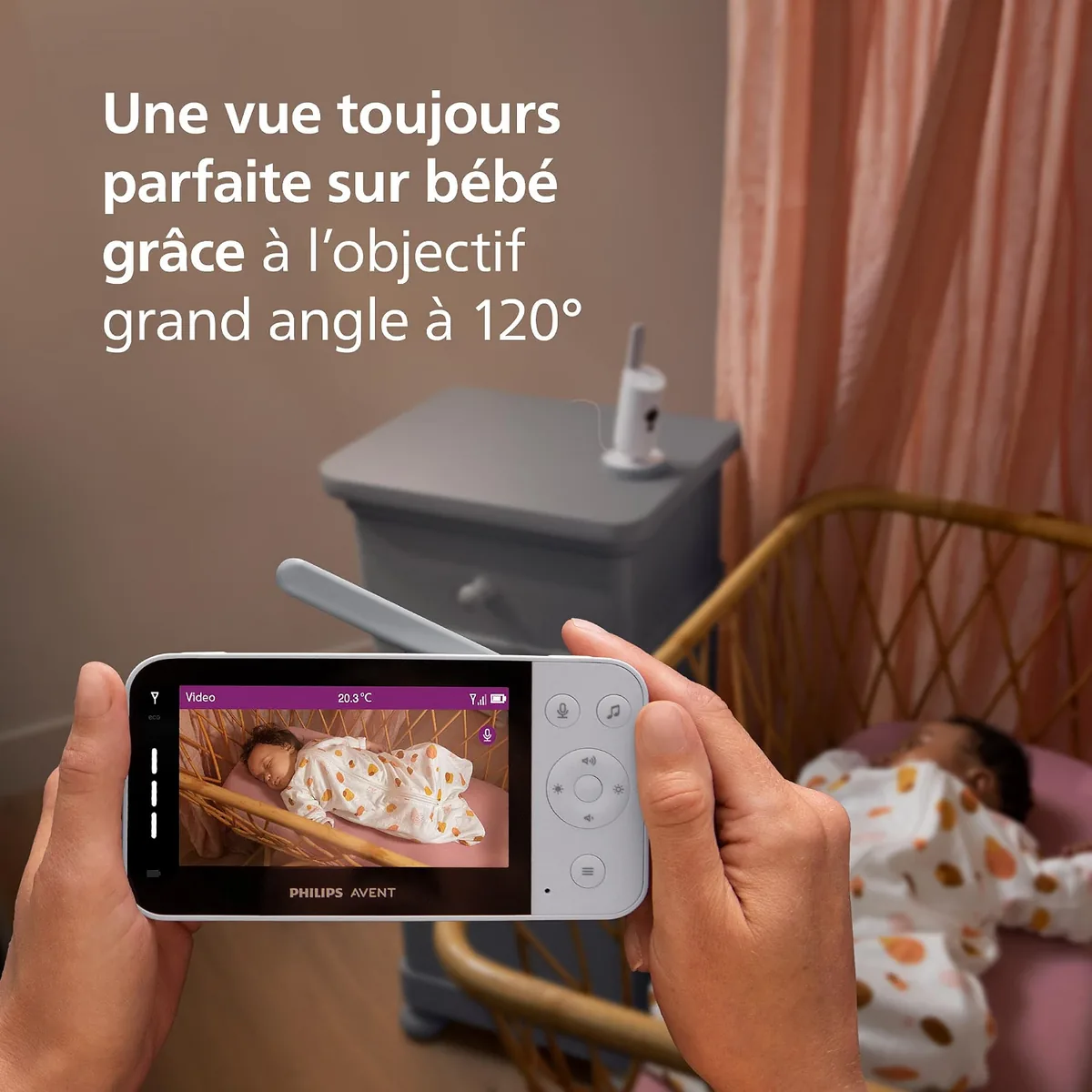
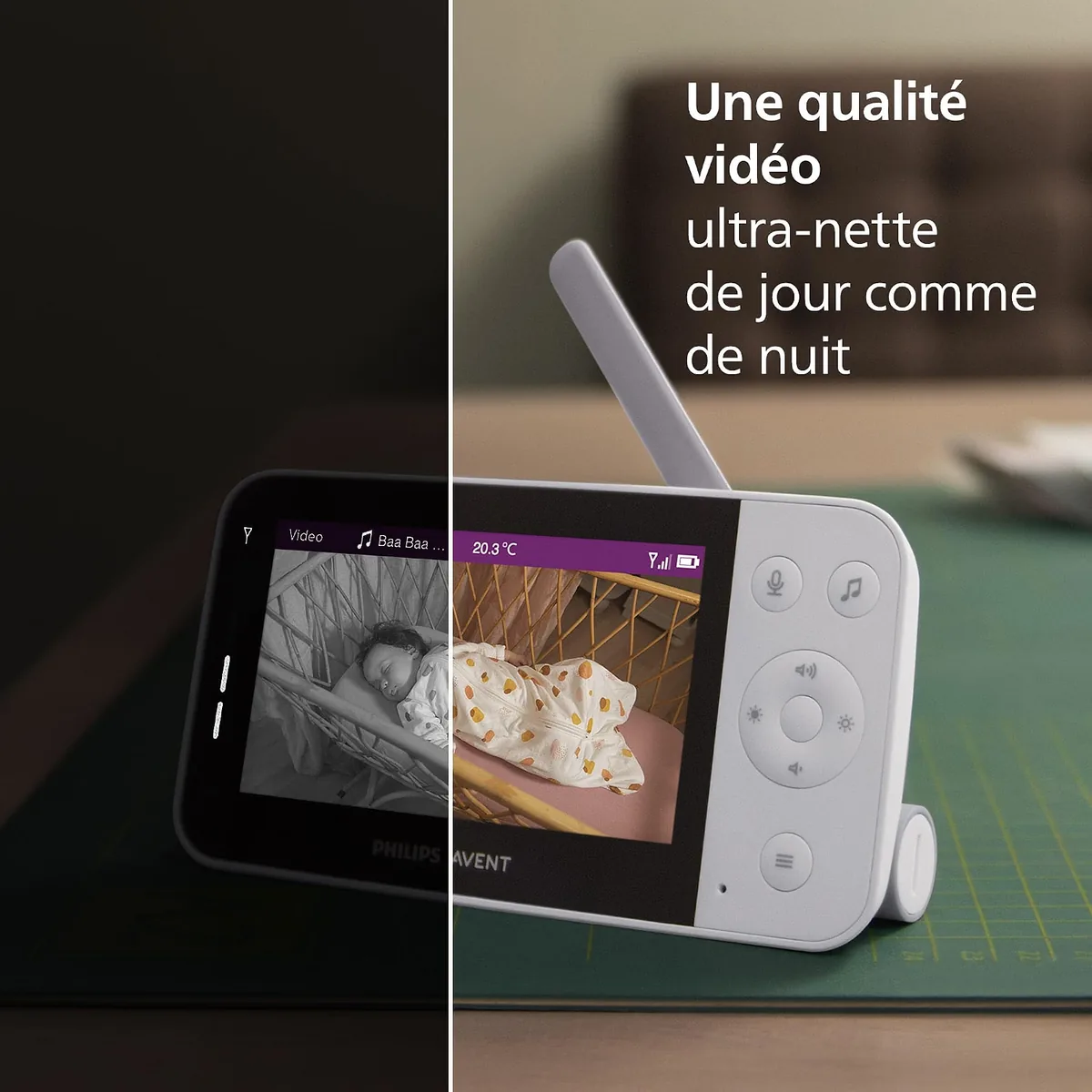
Like all video baby monitors, the SCD951/26 goes more than one metre from the cot. Its 120° lens and digital zoom let you see the whole mattress from a wall some distance away, and it can be wall-mounted. It has a built-in thermometer with an alert and a connection lost alert. Philips presents Secure Connect as several encrypted links and states that it does not store audio or video on its servers. The app is optional: without it, the baby monitor works over a direct link. Our full review details its strengths and limitations.
Frequently asked questions
How far from the cot should a baby monitor be?
At least one metre from any part of the cot, cable included. The CPSC asks for at least three feet, about 90 centimetres.
Can a baby monitor prevent sudden infant death?
No. Safe sleep remains the essential protection. The AAP advises against consumer devices that claim to prevent it.
What temperature should the nursery be?
Between 18 and 20 °C, according to Santé publique France.
Is a Wi-Fi baby monitor dangerous?
It needs a few precautions: a strong password, updates, a secure router. Well configured, it can be used with peace of mind.
Are baby monitor radio waves dangerous?
Devices meet regulatory limits. Anses recommends moderate use for children; distance greatly reduces exposure.
Articles in this section
An eye on your baby, anywhere.
Full HD camera · Night vision · With or without Wi-Fi · Talk back · 12 h in Eco mode. The price changes often on Amazon: check it, along with the seller, the exact model number (SCD951/26) and what is in the box, before you order.
Check the price on AmazonAffiliate link · new tab