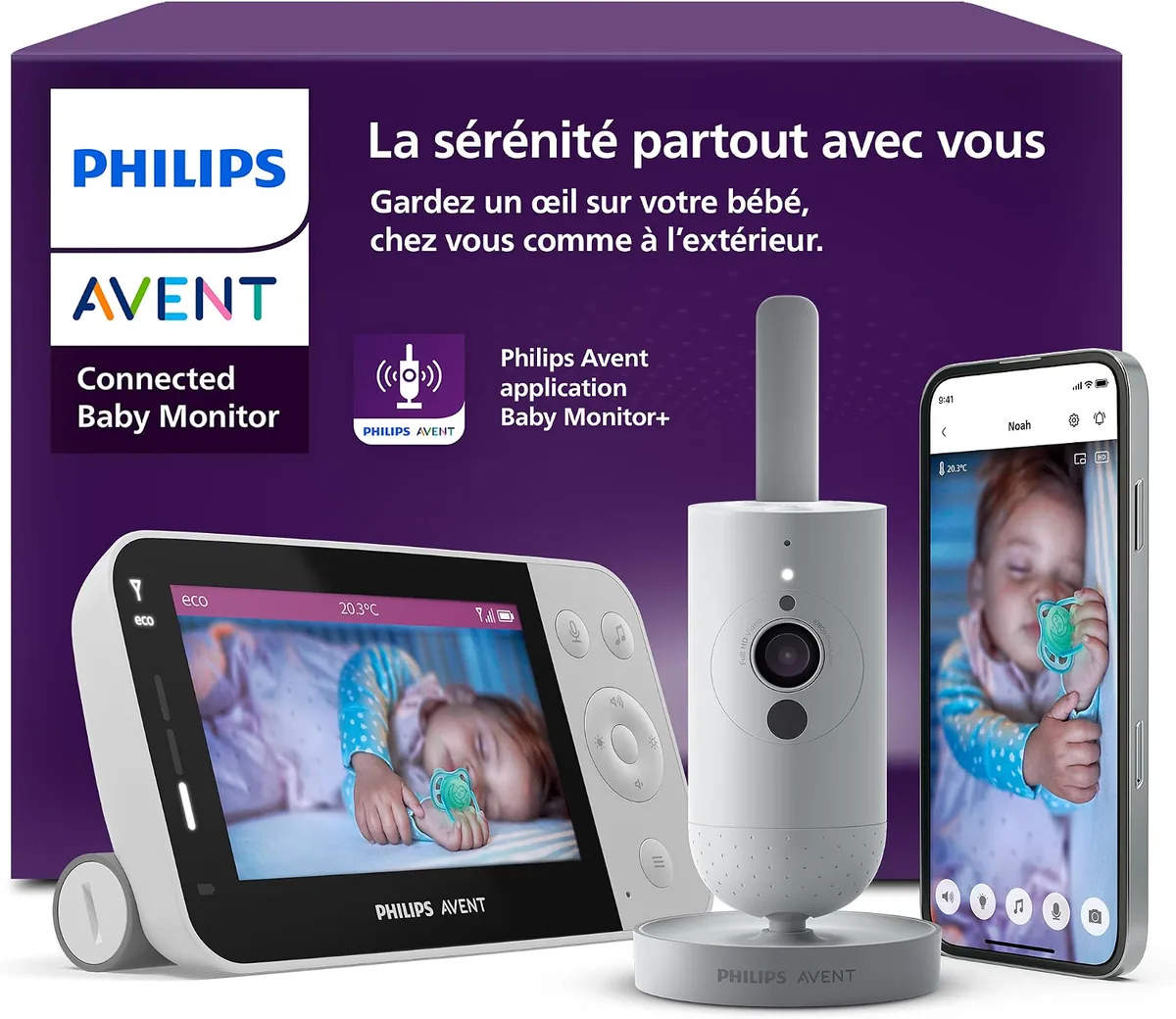
Baby monitors and radio waves: the facts, without alarmism
A baby monitor communicates by radio waves, like Wi-Fi or a phone. Should you worry about it for a baby? Here is what health authorities say, what the regulations require, and a few simple steps to limit exposure day to day.
Contents
How a baby monitor communicates
A baby monitor is made up of a baby unit, which picks up the picture and sound in the room, and a parent unit, which displays them. Between the two, the signal travels by radio waves, on a frequency band set aside for this kind of device. Connected models also use the home Wi-Fi to send the picture to an app on your phone.
These are the same families of waves as Wi-Fi, Bluetooth, cordless phones and mobile phones: radiofrequencies. The SCD951/26 uses the 2.4 GHz band, according to its Philips specification sheet, like many devices in the home.
What Anses says
The French agency for food, environmental and occupational health and safety (Anses) published a report in 2016 on children’s exposure to radiofrequencies. It notes that children may be more exposed than adults, because of their physical characteristics, and that the available data do not allow conclusions about effects on their health, while pointing to uncertainties and possible effects on certain functions that remain to be confirmed.
Anses therefore recommends moderate, controlled use of wireless technology by children, and calls for all radio devices intended for children to be subject to the same information and limitation requirements as mobile phones. Its message is not to ban these devices, but to reduce exposure where possible, without fuss.
Why children get particular attention
Health authorities apply a stronger precautionary principle to children, for several reasons: their bodies are still developing, their heads are smaller and their tissues different, and they will be exposed throughout their lives to recent technologies whose very long-term effects are still being studied. This caution does not mean a danger has been shown. It encourages us not to multiply sources of exposure needlessly, and to keep them at a distance when that is easy.
With a baby monitor, it is precisely that easy: you just need to place it well.
Distance, the first lever
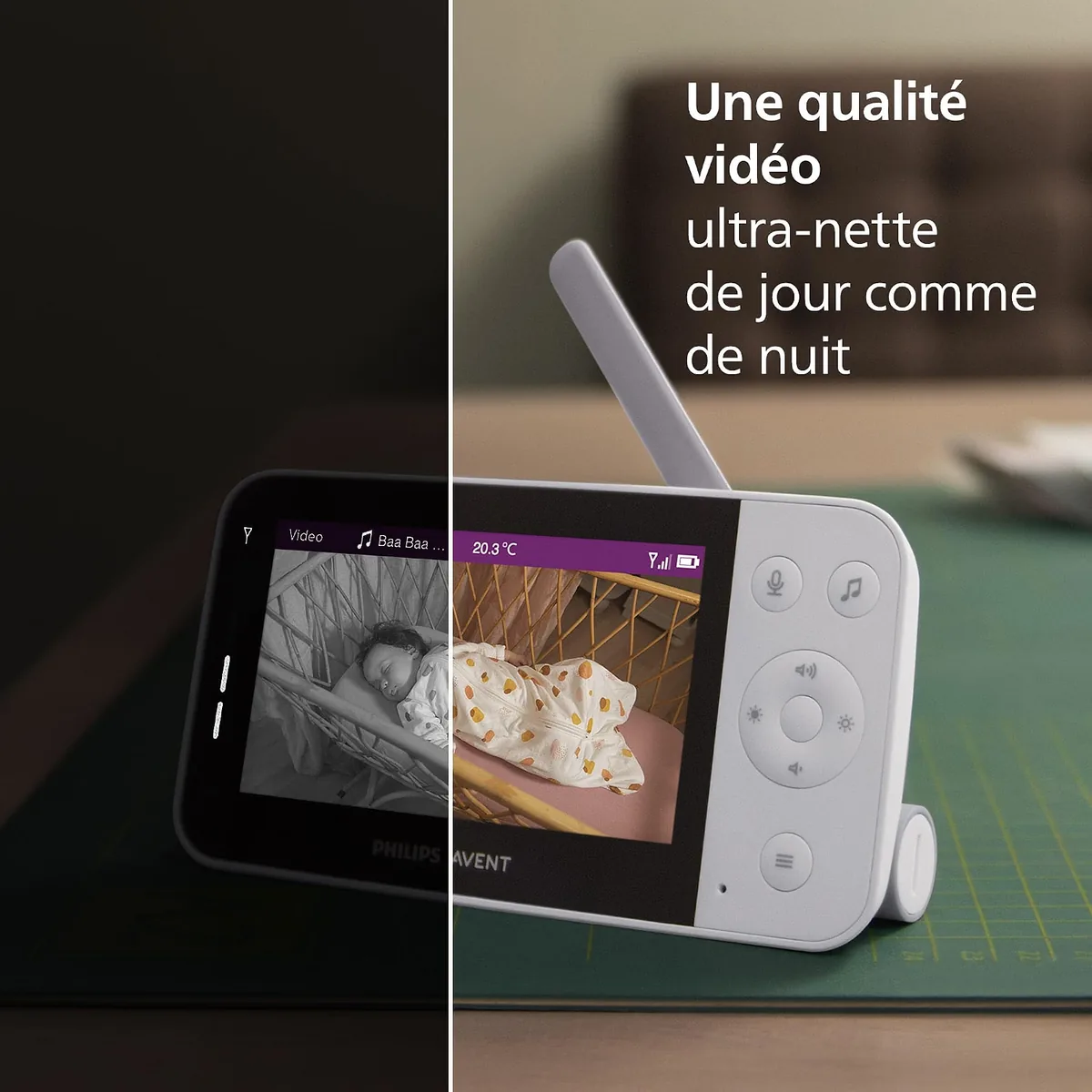
The strength of the waves received falls very quickly as you move away from the transmitter. Doubling the distance greatly reduces exposure. It is the most effective step, and it costs nothing. The good news: the safety rule that protects your baby from the cable, placing the camera at least one metre from any part of the cot, also keeps the transmitter away from their head.
Mounting the camera on the wall, up high, more than one metre from the cot, therefore addresses two concerns at once. A wide-angle lens and a digital zoom, such as the 120° and zoom of the SCD951/26 according to Philips, let you see your baby well from this distance. Our guide on setting up and adjusting a video baby monitor details the installation.
The 2.4 GHz band
The 2.4 GHz band is used by a large share of the wireless devices in the home: Wi-Fi routers, repeaters, Bluetooth speakers, smart devices, some cordless phones. It is free to use, provided maximum power levels set by regulations are respected. A baby monitor using it therefore does not add a new type of wave to the home: it joins the devices already working on it.
What matters for exposure is not so much the frequency as the power emitted, the duration and above all the distance. A device placed very close to the head for hours contributes more than a more powerful device placed far away.
What the regulations require
In the European Union, radio equipment, including baby monitors, must comply with Directive 2014/53/EU, known as the Radio Equipment Directive. It sets requirements for protecting people’s health and safety, and for efficient use of frequencies. Manufacturers must provide a declaration of conformity, generally available from the instructions or their website, and apply the CE marking.
In France, the national frequency agency (ANFR) checks devices placed on the market and publishes the results of its checks; in the UK, radio spectrum is regulated by Ofcom. Buy your baby monitor from an identifiable seller, and be wary of devices with no instructions in your language and no declaration of conformity.
Power-saving modes and emissions
Some baby monitors offer modes that reduce the device’s activity: screen off until your baby makes a sound, audio-only mode, power-saving mode. The SCD951/26 offers video, audio-only and Eco modes, according to Philips. These modes are designed above all to save the parent unit’s battery. As far as we know, Philips does not publish any figure on radio emissions by mode: we therefore cannot claim that they reduce exposure.
Other brands offer so-called “low emission” or “ECO” modes that reduce transmission when the baby is calm. If this criterion matters a lot to you, ask the manufacturer for precise data before buying, and be wary of promises without figures.
The parent unit and your pillow
The parent unit also transmits and receives. At night, put it on your bedside table, at arm’s length, rather than on the pillow or in the bed. This step has other advantages too: the parent unit cannot fall, it heats up less while charging, and its light disturbs you less.
If you breastfeed or give a bottle at night with your baby close to you, the parent unit has no use at that moment anyway: put it further away.
Wi-Fi, the app and radio waves
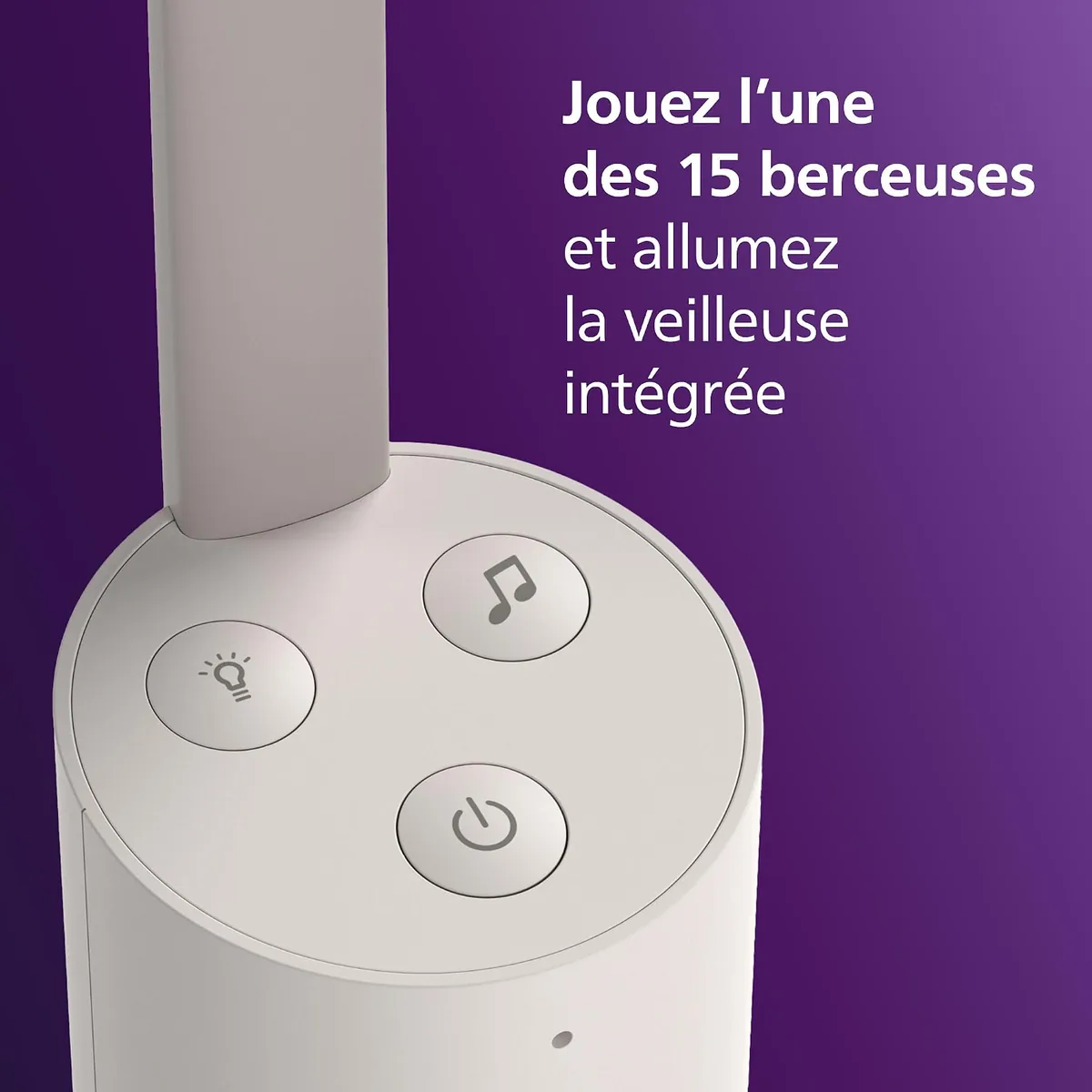
A hybrid model that uses the app also connects to the Wi-Fi router. If you do not need to watch your baby remotely, keeping the baby monitor on the direct link, without the app, limits the number of connections. It is also worthwhile for data security, as our article on baby monitor hacking explains.
Conversely, if you use the app, there is no need to also keep your phone next to your pillow at night: the dedicated screen, on the bedside table, is enough. Our article Wi-Fi or non-Wi-Fi baby monitor compares the two approaches.
Simple everyday steps
- Camera more than one metre from the cot, up high, ideally mounted on the wall.
- Parent unit on the bedside table, not on the pillow.
- Baby monitor switched off when not in use: during the day if your baby is not in their room, when you are together.
- App deactivated if you do not need it.
- Router and Wi-Fi repeaters kept away from the nursery if possible.
- Baby monitor put away when your child no longer needs it.
These steps are easy, and they match the safety and usage recommendations already given in our other guides.
The essentials: placing the baby monitor well, switching it off when it is not in use and keeping other wireless devices away from sleeping areas is enough to follow the spirit of the Anses recommendations.
Putting things in perspective
A baby monitor is just one source among others in a home. The Wi-Fi router transmits continuously, as do the parents’ phones, smart speakers and everyday connected devices. Acting on the baby monitor alone therefore has a limited effect if the router is in the nursery or a phone sleeps next to the cot.
The most useful approach is an overall one: keep the main sources away from sleeping areas, avoid multiplying unnecessary devices, and keep screens out of the child’s room.
Common misconceptions
“A non-Wi-Fi baby monitor does not emit radio waves”
A direct-link baby monitor also transmits: that is how the picture reaches the screen. It only avoids connecting to the router.
“Baby monitor radio waves are dangerous for babies”
Authorities have not shown any health effect at regulatory levels, and recommend moderation as a precaution. Distance greatly reduces exposure.
“Eco mode eliminates radio waves”
It reduces the parent unit’s activity. Without data from the manufacturer, it cannot be claimed that it eliminates or greatly reduces emissions.
“An audio baby monitor emits less than a video baby monitor”
Not necessarily: it all depends on the model, its power and its technology. Check the manufacturer’s data.
Should you give up the baby monitor?
For most families, no. A well-placed baby monitor, more than one metre from the cot, switched off when not in use, means moderate exposure, and it is genuinely useful as soon as your child sleeps in another room. In a small flat where you can hear your baby without a device, you can do without one, and that is a perfectly valid option.
The right approach is to use it when it is useful, and stop when it no longer is. Our article baby monitor: up to what age? helps you decide.
If radio waves matter a lot to you
Some parents want to reduce exposure as much as possible, and that is a legitimate choice. Several options are open to them. The first is to do without a baby monitor when the home allows it, in a small flat where you hear your baby directly. The second is to choose a direct-link audio model, without Wi-Fi, and place it far from the cot. The third, with a video baby monitor, is to mount it on the wall a good distance away, keep the app deactivated and switch it off as soon as it is no longer needed.
In every case, ask the manufacturer for its technical data and declaration of conformity before buying. A “zero emission” promise for a wireless device makes no sense: a baby monitor necessarily transmits by radio. What you can compare is how it transmits, and above all how you use it.
Other sources in the room
While you pay attention to the baby monitor, look at the rest of the room. A Wi-Fi router installed in the nursery, a repeater plugged in behind the cot, a smart speaker on the chest of drawers or a tablet left on at night are also sources of radio waves, often closer and more permanent. Anses recommends limiting the use of wireless devices for children: that applies to the whole room, not just the baby monitor.
The simplest approach is to keep the nursery a calm place: no router, no screen at night, a well-placed baby monitor, and nothing else connected unless it is useful. These choices also support better sleep.
Can you measure exposure at home?
Some parents wonder whether they should measure the waves in the nursery themselves. Consumer meters are available, but their accuracy varies widely, and their readings are hard to interpret without training: a figure on a screen, out of context, often creates more worry than it resolves. They are not necessary to apply the right steps, which work whatever the exact reading: distance, switching off when not in use, fewer devices near the cot.
In France, anyone can ask the national frequency agency (ANFR) for an official measurement of exposure in their home, carried out by an accredited laboratory, through a dedicated public scheme. In other countries, ask the national authority in charge of radio frequencies or public health what options exist. If you are worried, this is a more reliable route than an inexpensive meter bought online.
How to find reliable information
The subject of radio waves generates a lot of alarmist articles and miracle products. To find information, favour public sources: Anses opinions and reports, the websites of national frequency agencies, official government portals on radiofrequencies. Be wary of boxes, stickers or covers that claim to “neutralise” waves: none replaces distance, and some may even interfere with the device’s operation.
If you are unsure about a setting, the instructions and the manufacturer’s support page remain the most reliable references.
The SCD951/26 and radio waves
The SCD951/26 works on the 2.4 GHz band, over a direct link between its two units, and can connect to Wi-Fi for the app. It offers video, audio-only and Eco modes, and can be wall-mounted. Its 120° lens and digital zoom let you see your baby well from more than one metre away. Philips does not publish any emission figure by mode: we cannot present it as a “low emission” baby monitor. Well placed and switched off when not in use, it is used like any baby monitor, following the steps on this page.
Frequently asked questions
How far away should the baby monitor be to limit radio waves?
At least one metre from any part of the cot, as the cable safety rule requires. Further is even better, as long as the picture stays good.
Does a Wi-Fi baby monitor emit more?
It adds a connection to the router when the app is used. Without the app, a hybrid model stays on the direct link.
What does Anses recommend?
Moderate, controlled use of wireless technology by children, and better information about devices intended for them.
Should you switch off the baby monitor during the day?
Yes, when it is not in use: if your baby is with you or out of their room.
An eye on your baby, anywhere.
Full HD camera · Night vision · With or without Wi-Fi · Talk back · 12 h in Eco mode. The price changes often on Amazon: check it, along with the seller, the exact model number (SCD951/26) and what is in the box, before you order.
Check the price on AmazonAffiliate link · new tab