Philips Avent SCD951/26 review: what it does well, and less well
A video baby monitor that works straight out of the box, with no router, and an optional app for watching your baby from a distance. We went through it in detail, from the specification sheet to parents’ feedback.
Contents
The verdict in brief
The Philips Avent SCD951/26 gets right what you expect first from a video baby monitor: letting you see and hear your baby, day and night, without any fuss. Its camera and parent unit come already paired and talk to each other over a direct link, without going through your router. The Baby Monitor+ app comes on top, for watching your baby from work or from friends’ homes. The Full HD camera, automatic night vision and 120° lens let you see the whole cot from a camera placed well away from the mattress, which makes the one-metre safety rule easier to follow.
Two reservations before you buy. The first is the price: this is a premium baby monitor, and that is the most frequent criticism. The second is the screen: 4.3 inches and 480 x 272 pixels is enough for monitoring but less sharp than the camera picture seen in the app. Add to that a camera you aim by hand, with no motor.
Strengths
- Direct link: works without Wi-Fi
- Optional app, over Wi-Fi or mobile data
- Full HD camera, automatic night vision
- 120° wide-angle lens, digital zoom
- Stated encrypted links (Secure Connect)
- Talk back, soothing sounds, night light
- Room thermometer with alert
Limitations
- High price
- Camera can only be aimed by hand
- 4.3-inch screen at 480 x 272
- Baby unit on mains power only
- 12 h battery life in Eco mode only
- No breathing monitoring
The SCD951/26 at a glance
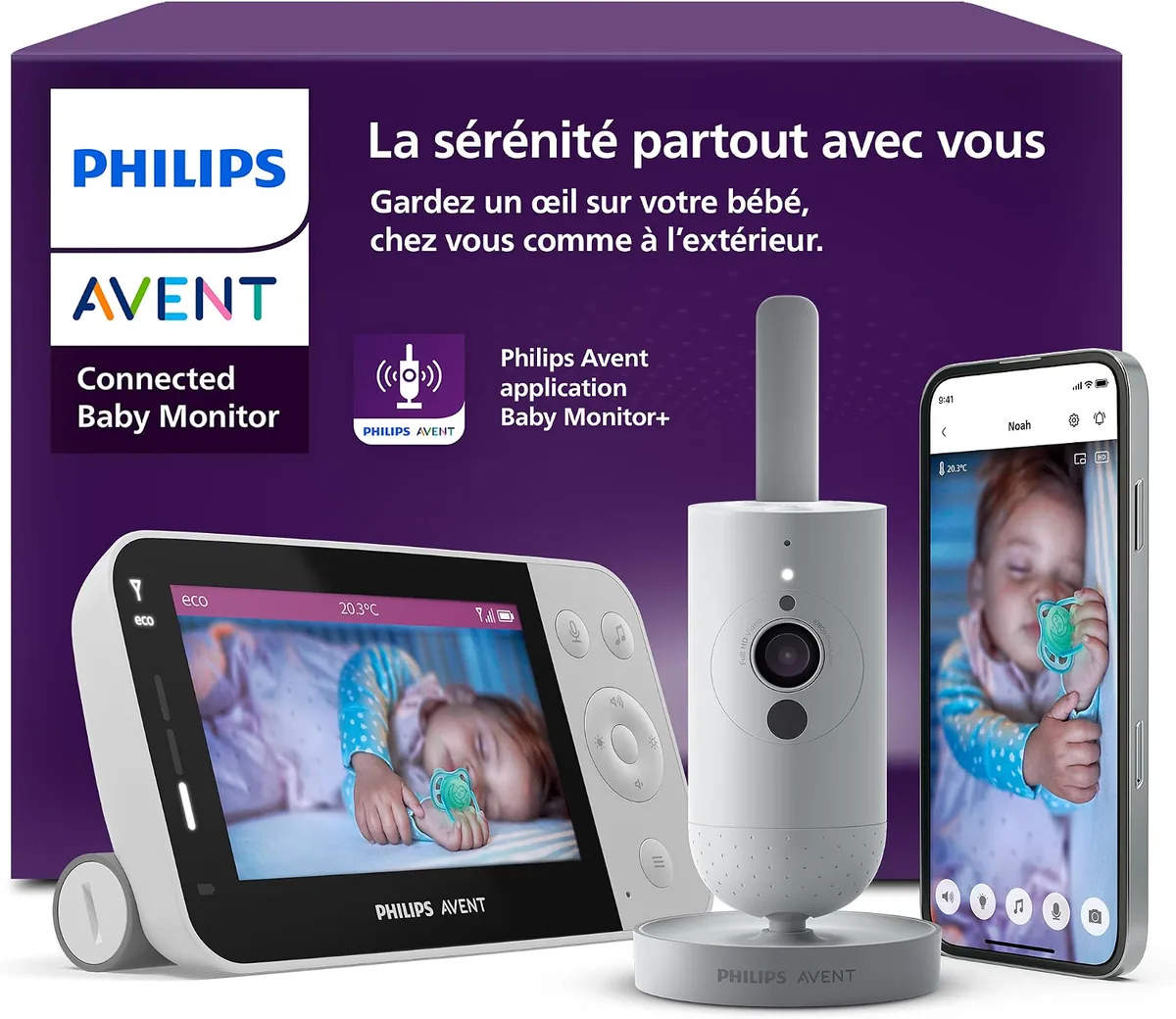
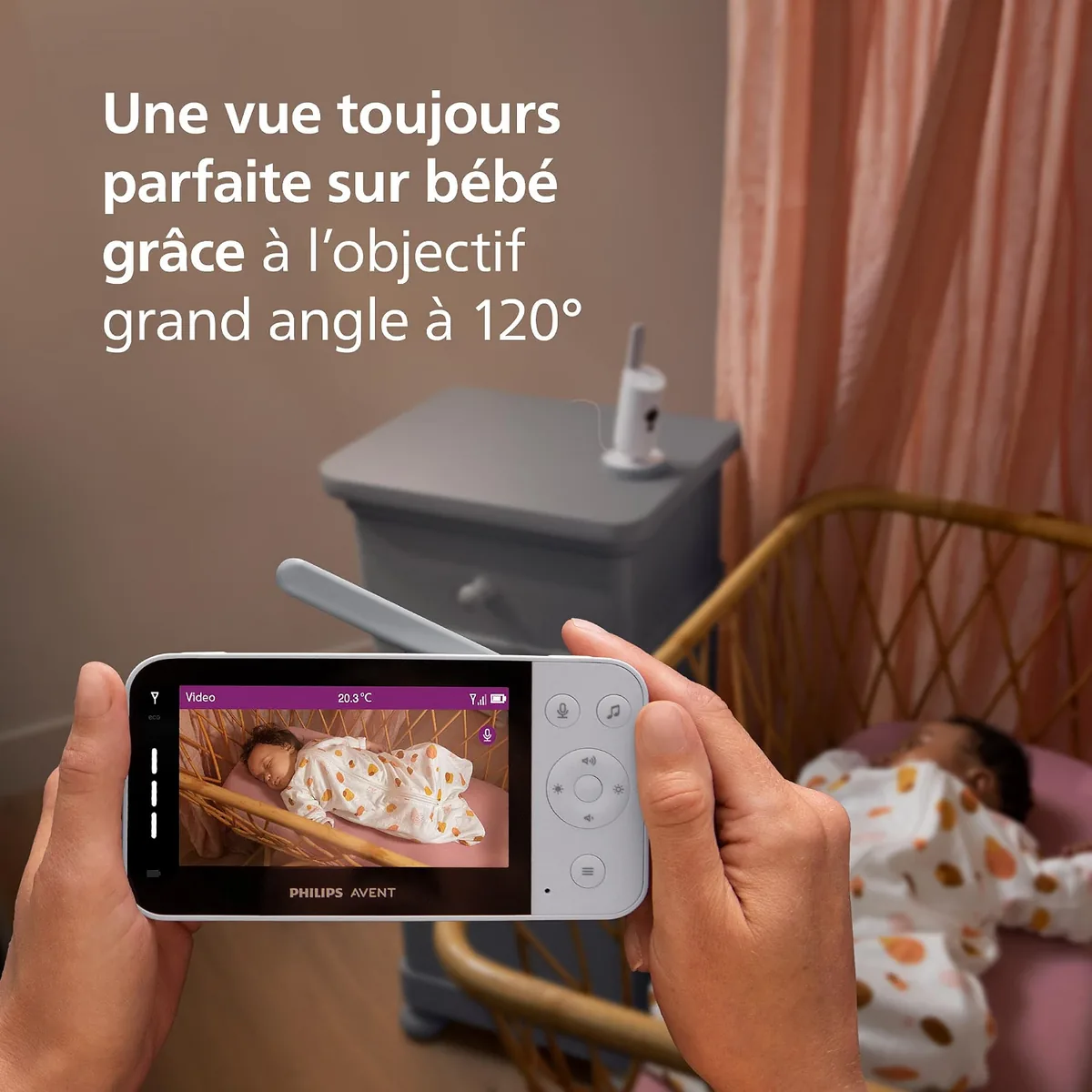
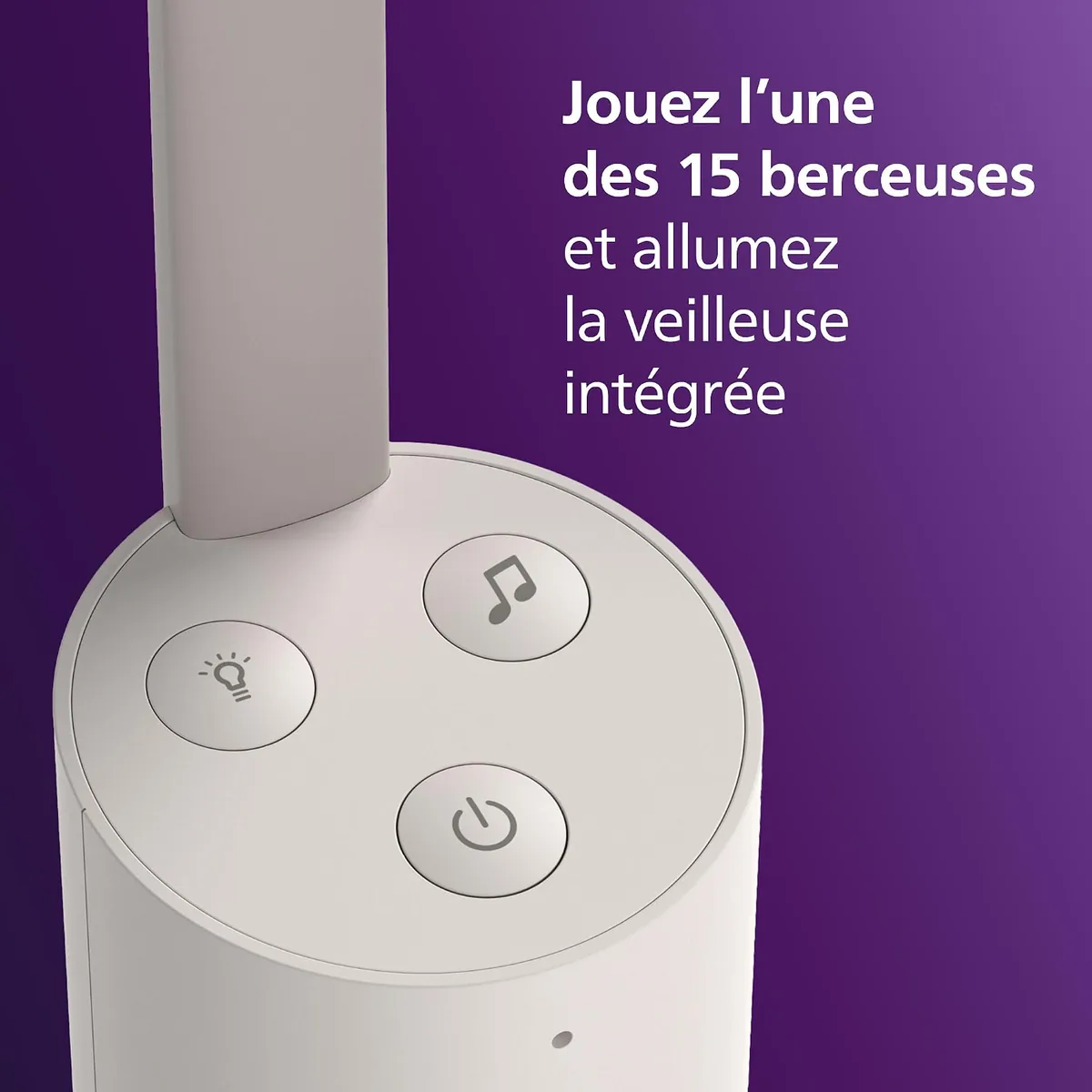
According to the product sheet, the box contains a parent unit, a baby unit, a power supply with adapter, a USB-C to USB-A cable and access to the Baby Monitor+ app. The baby unit is a small white column on a stand, with the camera at the front and the night light, lullaby and power buttons on top. The parent unit looks like a small pocket screen on a stand, with a navigation pad and buttons to talk to your baby or play a sound.
The data in this review come from the Philips specification sheet, its support pages and retailers’ listings. Usage feedback comes from reviews published on the manufacturer’s and retailers’ websites, summarised without names or quotes. We did not receive the device from the brand.
A direct link, with or without Wi-Fi
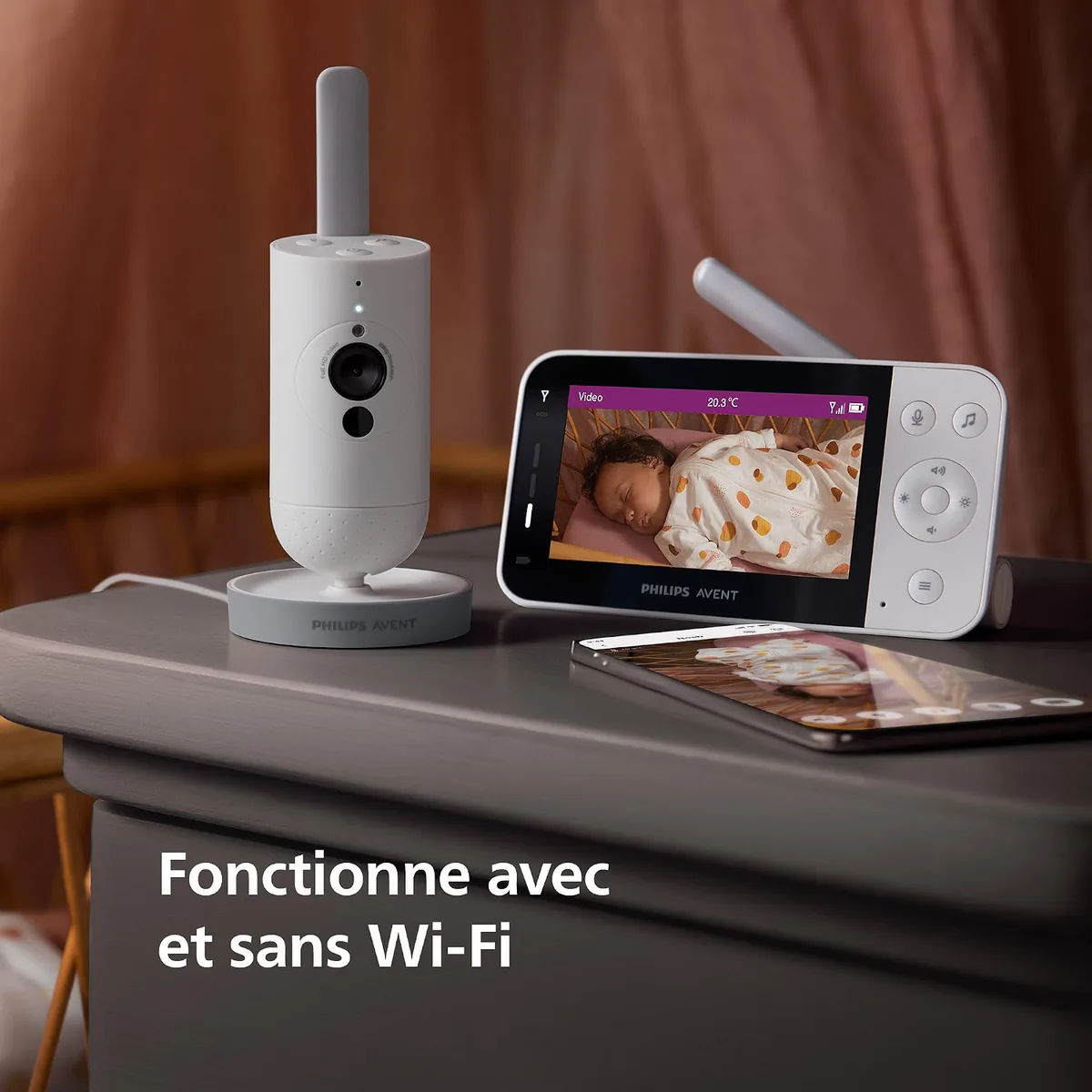
This is what sets this model apart from standard Wi-Fi cameras. Philips states a “direct (peer-to-peer) and Wi-Fi” connection mode. In practice, the camera and the screen communicate with each other without a router: you plug them in, switch them on and the picture appears. No account to create, no network to configure for basic use. If your router fails or restarts during the night, the screen keeps receiving the picture.
Wi-Fi only comes into play if you want the app. You link it to the camera whenever you like, and it takes over via the internet when you are out of range of the direct link. For a family hesitant about putting a connected camera in the nursery, this design lets you start without the app and add it later. Our article Wi-Fi or non-Wi-Fi baby monitor compares the three designs.
The camera: Full HD, 120°, night vision
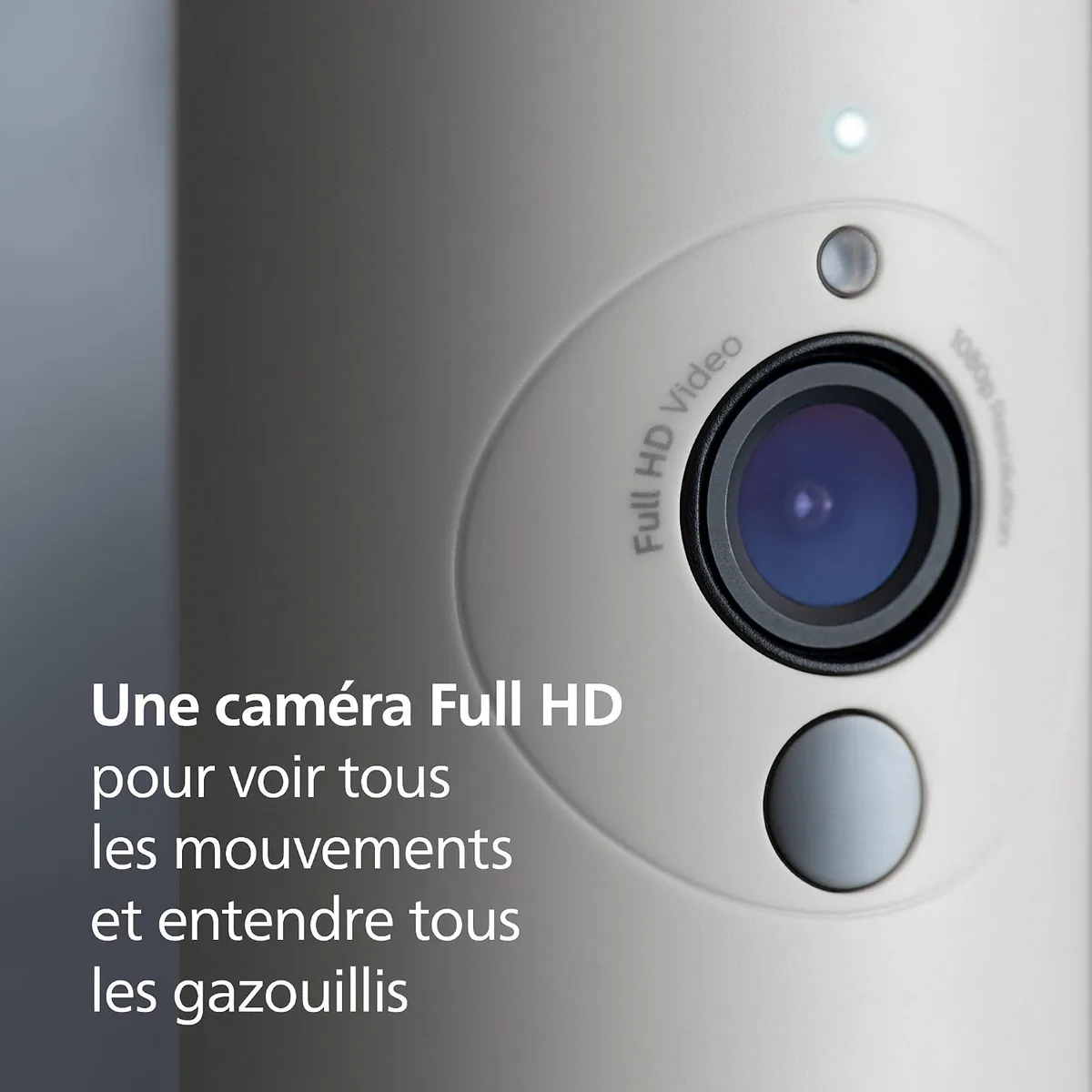
The camera records in Full HD 1080p, according to Philips. It switches automatically to night vision when the room gets dark, and the picture then turns black and white. The zoom is digital, with pan: you enlarge an area of the picture and move around it, without the camera moving. The 120° wide-angle lens, with an adjustable camera angle, covers a whole cot from a wall or a chest of drawers some distance away.
The direction is set by hand. Several published reviews regret this: you cannot turn the camera from the screen or the app if your baby has moved into a corner of the cot. With the wide angle, this is mainly an issue as the child grows and sleeps in a wider bed. Once the camera is framed on the whole mattress, the zoom is usually enough.
The parent unit and its screen
The parent unit has a 4.3-inch colour LCD screen showing 480 x 272 pixels. That is a modest resolution compared with the camera: the screen does not show all the detail of the Full HD picture, which comes through better in the app on a phone. For night-time use, this is not a major flaw: you look at the screen for a few seconds to see whether your baby is asleep or restless, and a smaller screen lights up the room less.
The parent unit runs on battery and mains power. It offers an Eco mode, which saves power, and an audio-only mode, which turns off the picture and keeps the sound. At night, audio-only mode has two advantages: the battery lasts longer, and the light from the screen does not disturb you. The screen comes back on when your baby makes a sound, according to the Philips description.
Range and battery life
Philips states a range of up to 50 metres indoors and 400 metres outdoors between the parent unit and the baby unit, and unlimited range via the app with an internet connection. These figures are maximums. Indoors, every load-bearing wall, every concrete floor and every device transmitting on the 2.4 GHz band reduces the real range. Several parents report a stable connection between floors and over good distances in their reviews; that is encouraging, but nothing replaces a test in your own home before the first night.
The parent unit is rated for 12 hours of battery life in Eco mode, after a full charge. One published review notes that the battery needs recharging after a nap and an evening of use. The simple habit: plug the parent unit in on your bedside table at night, and keep the battery for naps and evenings. The stated box contents include a single power supply; one review points out that you need a USB charger for the parent unit. Our calculator checks range and battery life for your set-up.
The Baby Monitor+ app
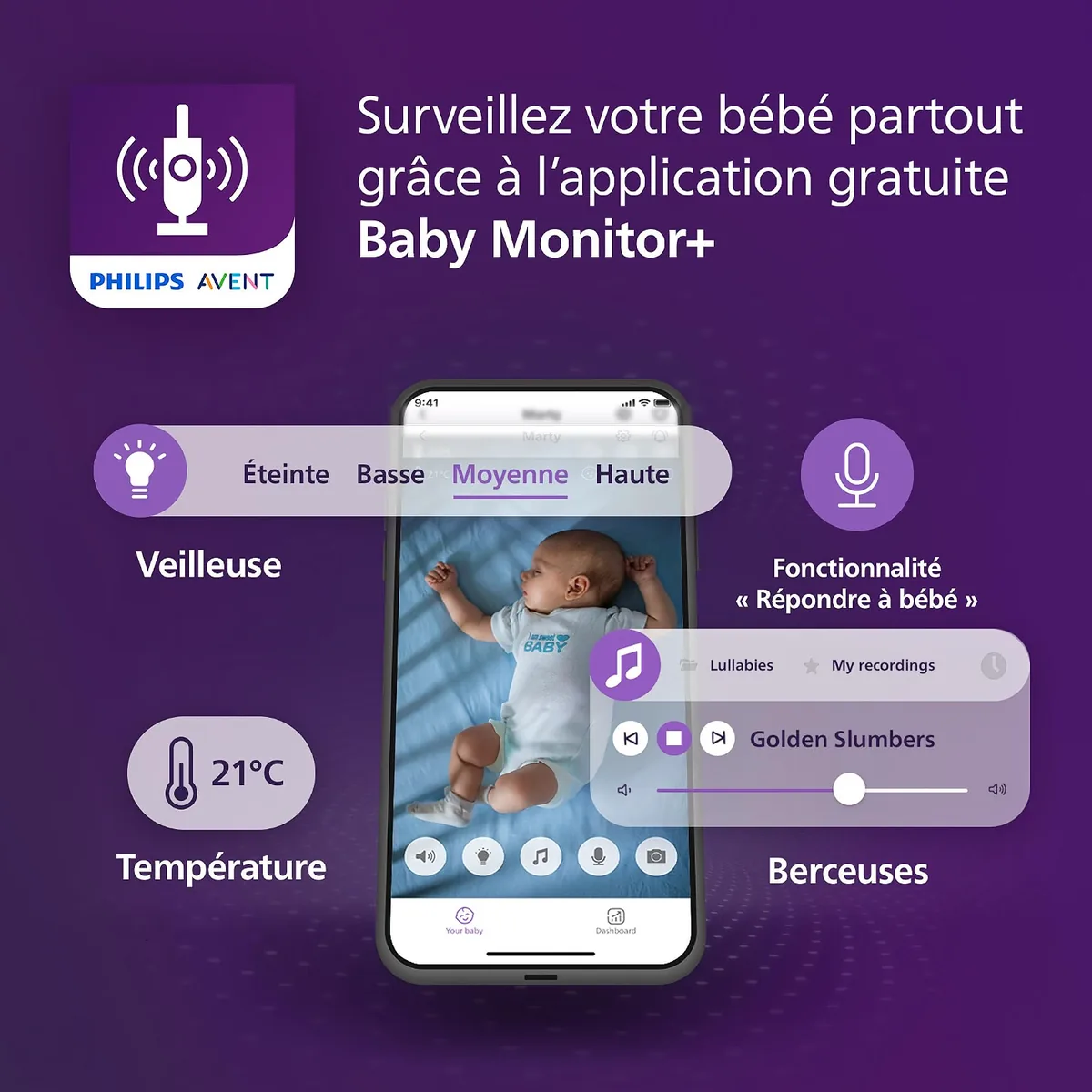
The Baby Monitor+ app runs on iOS 11 and Android 6 and later versions, according to Philips. It shows the camera picture over Wi-Fi or mobile data, lets you talk to your baby, play a sound or switch on the night light, and record personalised sounds, such as your own voice singing a nursery rhyme. Philips also mentions background listening: you hear your baby even with your phone locked or while using other apps.
The app is mainly useful when you are away: at the office while your baby is looked after at home, at friends’ in the evening, or at the far end of a large garden out of range of the direct link. It comes with a trade-off: it depends on your router, your mobile network and the security of your account. Our article on watching your baby remotely with the app explains how to use it without exposing yourself.
Secure Connect and data protection
Philips presents its Secure Connect system as several encrypted links between the baby unit, the parent unit and the app. On its support page, the brand states that the connected baby monitor transmits and stores data using industry-standard encryption technology, that the security solution is updated, and that the audio and video data transmitted are not stored on its servers. The brand’s visuals also highlight a DEKRA cybersecurity certification.
These are the manufacturer’s statements, which we cannot verify ourselves. An independent test by Test-Achats, published at the end of 2022 on ten video baby monitors, ranked the big brands, including Philips with a closely related model, among the best for security, with flaws judged less serious than those of other devices. Whatever the brand, your part matters: a strong, unique password for the account, updates, a protected router and no public Wi-Fi. Our guide to baby monitor hacking details these habits.
Check the price on AmazonPhilips Avent SCD951/26 baby monitor · new tabTalk back, lullabies, night light
The “Talk back” function lets you talk and listen at the same time, as on the phone, according to Philips. It is not a walkie-talkie where you press to speak: the conversation goes both ways. Several parents like it for settling a light waking without going into the room. The baby monitor also offers lullabies, soothing sounds and white noise with a timer, 15 sounds in all according to the product sheet, and a night light built into the baby unit, also with a timer.
These functions can be started from the parent unit, from the app or from the buttons on the camera. One review regrets that the lullaby volume steps are too far apart. In everyday use, keep the night light soft and the volume low, and switch them off with the timer: the aim is to help your baby fall asleep, not to fill the night.
Thermometer and alerts
The built-in room thermometer shows the room temperature and triggers an alert if it gets too high or too low, according to Philips. This is useful for keeping the room between 18 and 20 °C, as recommended by Santé publique France and its “first 1,000 days” website. The sheet lists other alerts: low battery, connection lost, sound and motion detection.
The connection lost alert deserves special attention: it warns you when the parent unit is no longer receiving the camera, for example if you go out of range or a plug has been pulled out. Keep it on. Sound and motion alerts can be set according to how you sleep and your baby’s temperament, so that you are not woken at every sigh.
Installation and cable safety
The baby unit runs on mains power only, so there is always a cable coming from the camera. It is this cable that dictates the most important rule. The US Consumer Product Safety Commission asks parents to keep baby monitors and cords at least three feet, about one metre, from any part of the cot, after several infant deaths by strangulation. The SCD951/26 camera can be mounted on the wall, according to Philips: that is often the best solution, up high, with the cable fixed along the wall down to the socket.
The 120° wide angle lets you see the whole cot from that distance. Tilt the camera by hand to frame the mattress, then check from the parent unit. Our user guide details each step, and our guide to video baby monitor safety covers all the safety instructions.
A day with the SCD951
To judge a baby monitor, you need to picture it in a real day. In the morning, your baby has a first nap in the nursery while you work in the living room: the parent unit, in audio-only mode, sits on the table, and the screen lights up when your baby makes a sound. Early in the afternoon, you go out into the garden: the parent unit comes with you, on battery. In the evening, your baby falls asleep while you have dinner: a glance at the screen is enough to know whether you need to get up or whether they will settle on their own, and “Talk back” sometimes lets you reassure them with your voice.
One day a week, your baby is looked after at home by a grandparent. From the office, the app lets you see them sleeping, without calling or disturbing anyone. At night, the parent unit is plugged in on your bedside table, brightness at minimum. This scenario shows the place we give the baby monitor: a relay that lets you get on with life in another room, never a substitute for safe sleep and the presence of an adult.
What parents say
We read the reviews published on the manufacturer’s UK website, where the model has an average rating of 4.3 out of 5 and a large majority of recommendations, as well as retailers’ reviews. Without naming anyone or copying reviews, here are the trends that come up:
- a sharp picture day and night, with good night vision;
- a stable connection, including between floors and over good distances;
- quick set-up, usable straight out of the box;
- remote access through the app;
- the night light, the “Talk back” function, the lullabies and the temperature display.
- a price considered high;
- a camera that can only be aimed by hand;
- battery life considered a little short by one heavy user;
- lullaby volume steps too far apart for some;
- a charger to buy separately for the parent unit, according to one review.
Our full summary is on the page is the Philips Avent SCD951/26 worth it?
Similar model numbers: avoiding confusion
Philips offers its connected baby monitor in several closely related versions: SCD921/26, SCD923/26, SCD951/26 and SCD953/26, with very similar specification sheets (direct link and Wi-Fi, Full HD camera, 4.3-inch screen, 50 m / 400 m range, 12 hours in Eco mode). The brand also sells a connected camera on its own, without a parent unit (SCD643/26), and a premium monitor with a 5-inch screen and sleep and breathing tracking without a wearable sensor (SCD973). Check the exact model number before ordering: the SCD951/26 is the one we present here.
Compared with other types of baby monitor
To put the SCD951/26 in context, let us compare it with the main families rather than with a specific model. An audio baby monitor costs much less, often lasts longer on battery and is enough in a small home, but it does not show whether a cry means you need to get up. A video baby monitor without an app gives you the picture without any internet connection, which is reassuring for privacy, but does not let you watch your baby away from home. A Wi-Fi-only camera often costs less and uses your phone as the screen, but depends entirely on your router and on notifications, and has no dedicated screen for the night.
The SCD951/26 combines the dedicated screen and direct link of a classic video baby monitor with the remote access of a connected camera. For us, that is what justifies its positioning. If you never need to watch your baby away from home, a cheaper video model without an app will do. Our guide on how to choose a video baby monitor helps you decide.
Who is it for?
The SCD951/26 is aimed at parents who want a video baby monitor that is reliable straight out of the box, usable without Wi-Fi, with the option of watching their baby remotely when they need to. It suits houses on several floors and families who regularly leave their baby with a relative. It is less suited to tight budgets, to those who want a motorised camera or a large high-definition screen, and to those looking for breathing monitoring, which is not what it does.
Frequently asked questions
Does the SCD951/26 work without Wi-Fi?
Yes. The camera and the parent unit communicate over a direct link. Wi-Fi is only used for the app.
How big is the screen?
4.3 inches, colour LCD, 480 x 272 pixels, according to Philips.
Can the camera be turned remotely?
No. The angle is set by hand. The digital zoom with pan lets you frame an area of the picture.
What is the parent unit’s battery life?
12 hours in Eco mode after a full charge, according to Philips. Plug it in at night.
Can the camera be mounted on the wall?
Yes, wall mounting is possible according to the Philips sheet. Keep the camera and the cable more than one metre from the cot.
Does it monitor the baby’s breathing?
No. It is a video baby monitor, not a medical device. Safe sleep remains the best protection.
An eye on your baby, anywhere.
Full HD camera · Night vision · With or without Wi-Fi · Talk back · 12 h in Eco mode. The price changes often on Amazon: check it, along with the seller, the exact model number (SCD951/26) and what is in the box, before you order.
Check the price on AmazonAffiliate link · new tab