Choosing a video baby monitor: the 12 criteria that matter
Audio, video, Wi-Fi, hybrid: baby monitors look alike in photos and differ a lot in use. Here are the twelve criteria to go through, in order of importance, to choose without getting it wrong.
Contents
Start from your home and your days
Before comparing specification sheets, ask yourself a simple question: in which situations will you really use this baby monitor? The answer changes everything. In a flat where the nursery is a few metres from the living room, the baby monitor will mainly be used during naps and evenings, and range will never be a problem. In a house on three floors, with thick walls and a garden, the quality of the link becomes the number one criterion. If your baby is looked after at home by a relative while you work, remote access through an app makes complete sense.
Think about your habits too. Some parents want a screen they can glance at during the night; others prefer to hear only the sound and look at the picture only when in doubt. Some are keen to avoid any internet-connected camera in their child’s room; others find it reassuring to check from the office that the nap is going well.
Finally, keep in mind what a baby monitor does not do. The American Academy of Pediatrics points out, in its 2022 recommendations, that no commercial product should be presented as a way to reduce the risk of sudden infant death, and does not recommend home cardiorespiratory monitors as a prevention strategy. A baby monitor is a relay between two rooms, not medical protection. What protects your baby is safe sleep.
The families of baby monitors
| Type | How it works | Who it suits |
|---|---|---|
| Audio baby monitor | Sends sound to a parent unit, with no picture | Small homes, tight budgets, parents who do not want a camera |
| Direct-link video baby monitor | Dedicated camera and screen, linked by radio with no router | Parents who want the picture without an internet connection |
| Wi-Fi camera | Camera linked to the router, picture in the phone app | Parents who mainly want to watch their baby from a distance |
| Hybrid baby monitor | Dedicated screen over a direct link, plus an app | Parents who want the reliability of a direct link and remote access |
| Sleep monitor | Camera or sensor that analyses movement or breathing | A separate category, which does not replace medical advice |
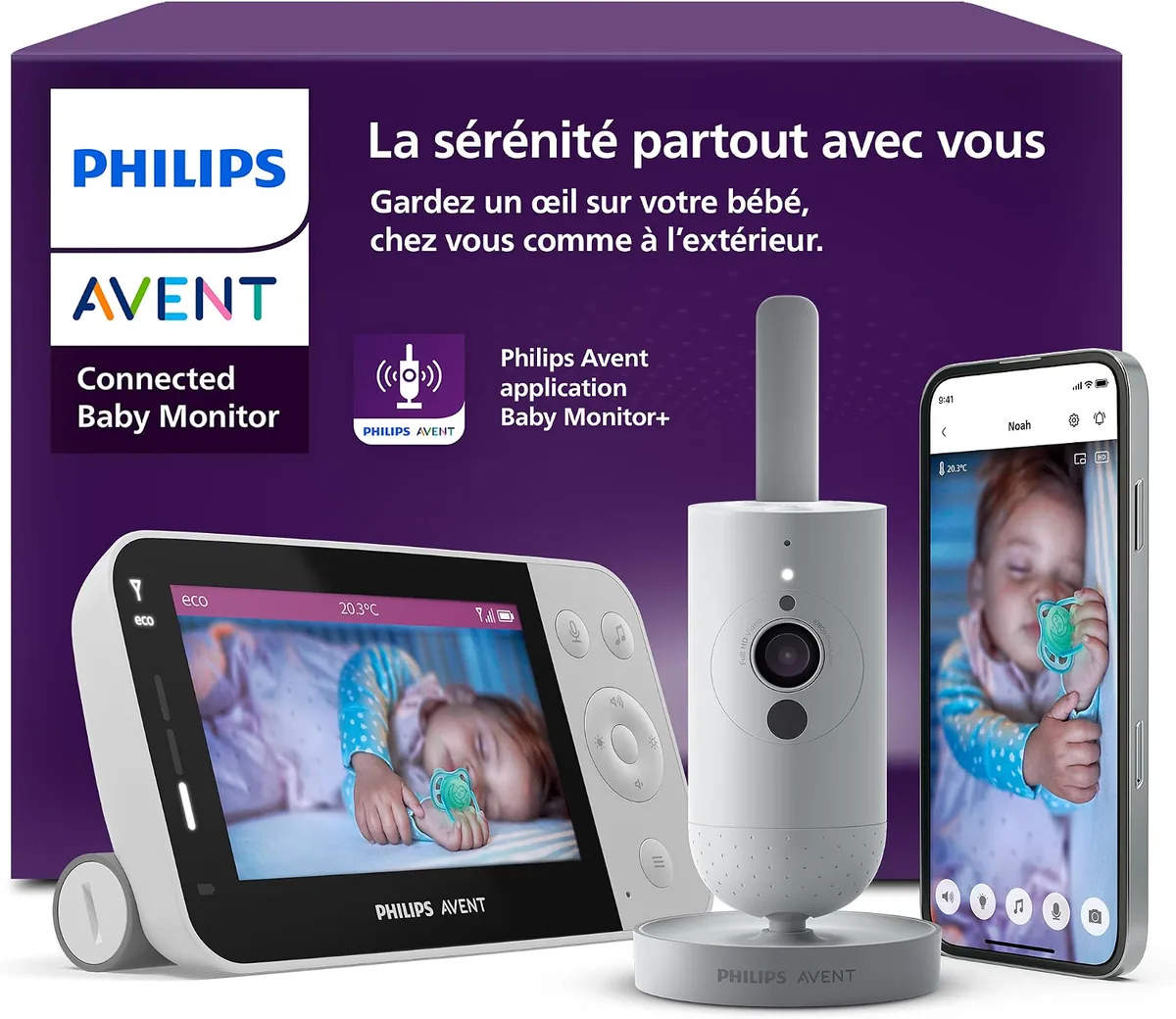
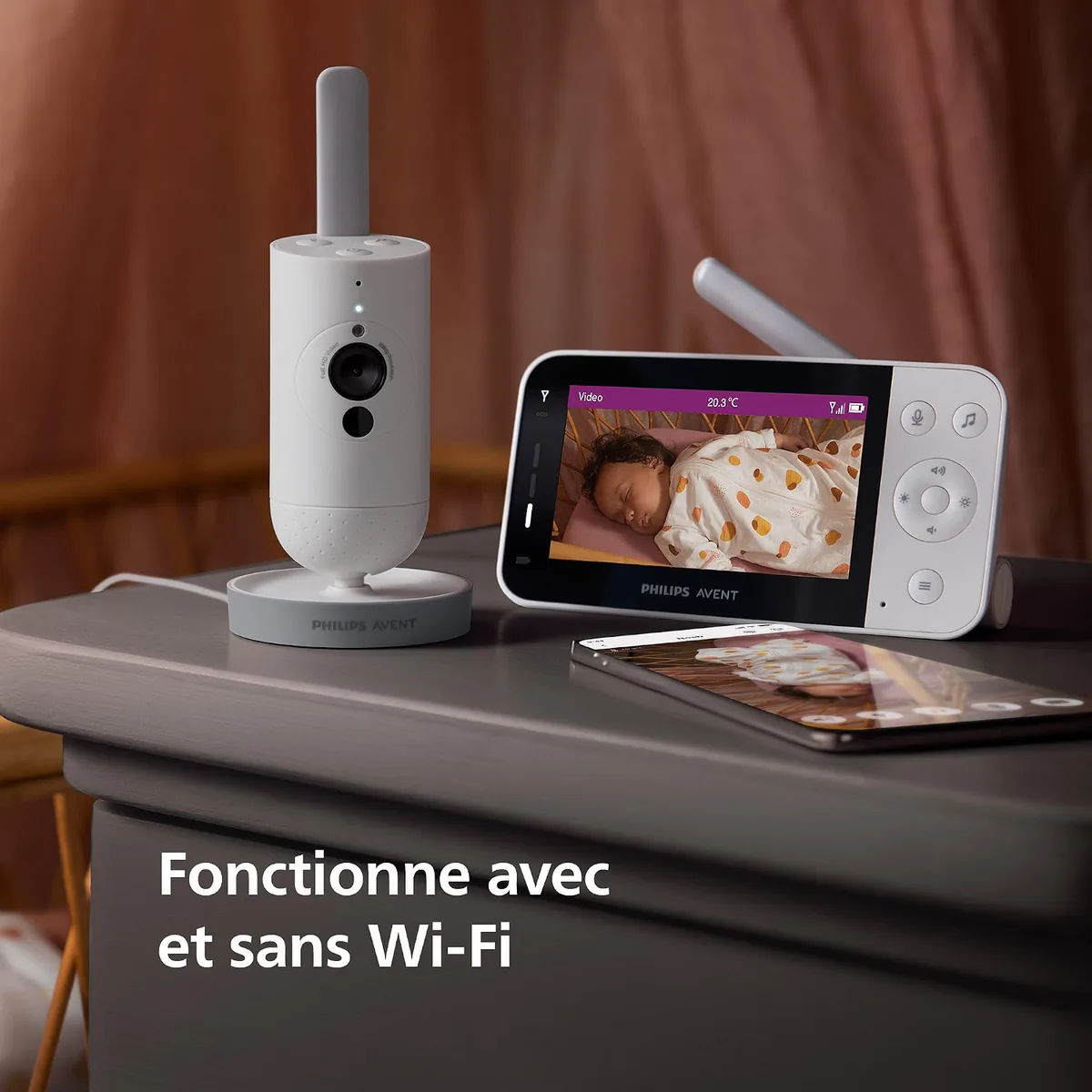
The Philips Avent SCD951/26, our reference model, belongs to the hybrid family: its camera and parent unit communicate over a direct link, and the Baby Monitor+ app adds remote access. Our article Wi-Fi or non-Wi-Fi baby monitor explains these designs in detail.
Criterion 1: audio or video
An audio baby monitor sends the sounds from the room: crying, babbling, coughing. It is light, often has a long battery life and costs less. It is enough for many families, especially in a small home where you can already hear your child from a distance. Its limit shows at night: a noise does not tell you whether your baby has really woken up, whether they are settling back to sleep or simply moving in their sleep.
A video baby monitor answers that question at a glance. It means you do not get up for a simple sigh, and you get up faster when your baby really is awake. It reassures anxious parents in the first weeks, and becomes handy as the child grows and moves around in the cot. The trade-off: a higher price, often shorter battery life and, for connected models, privacy questions to take seriously.
Criterion 2: the type of link
A direct link connects the camera and the screen by radio, without going through the router. It works even if the internet goes down, and does not expose the picture on the network. A Wi-Fi camera goes through the router and often through the manufacturer’s servers: you can watch your baby from anywhere, but it depends on the network, your phone’s notifications and the security of your account. A hybrid model combines the two, and it is the design we recommend to most families.
Ask yourself a practical question: if the router restarts at 3 a.m., what happens? With a direct link or a hybrid model, the screen keeps receiving the picture. With a Wi-Fi-only camera, you lose the picture and sometimes the alert, without necessarily knowing it. For night-time monitoring, this difference matters.
Criterion 3: real-world range
Manufacturers state maximum ranges, measured in good conditions. Philips, for example, states up to 50 metres indoors and 400 metres outdoors for the SCD951/26. In your home, the range depends on the thickness of the walls, concrete floors, metal furniture and other devices transmitting on the same frequency band. An old house with stone walls can cut the link well before the stated distance.
Count the walls and floors between the nursery and the rooms where you will be: living room, kitchen, study, garden. Beyond two or three thick obstacles, allow a margin, choose a model with a longer stated range, or a hybrid model whose app will take over via the internet. Our article on baby monitor range and battery life explains how to test at home.
Criterion 4: the parent unit’s battery life
The stated battery life is often measured in a power-saving mode, with the screen off or dimmed. Philips, for example, states 12 hours for the SCD951/26 parent unit in Eco mode, after a full charge. With the screen on all the time, brightness at maximum and loud volume, real battery life will be shorter. Always check which mode the battery life refers to.
For the night, the simplest option is to plug the parent unit in on your bedside table. The battery is then used for naps, evenings and time in the garden. Check that the box contains what you need to charge the parent unit, and that the charging port is a common one: a USB-C port lets you use a phone charger.
Criterion 5: the night picture
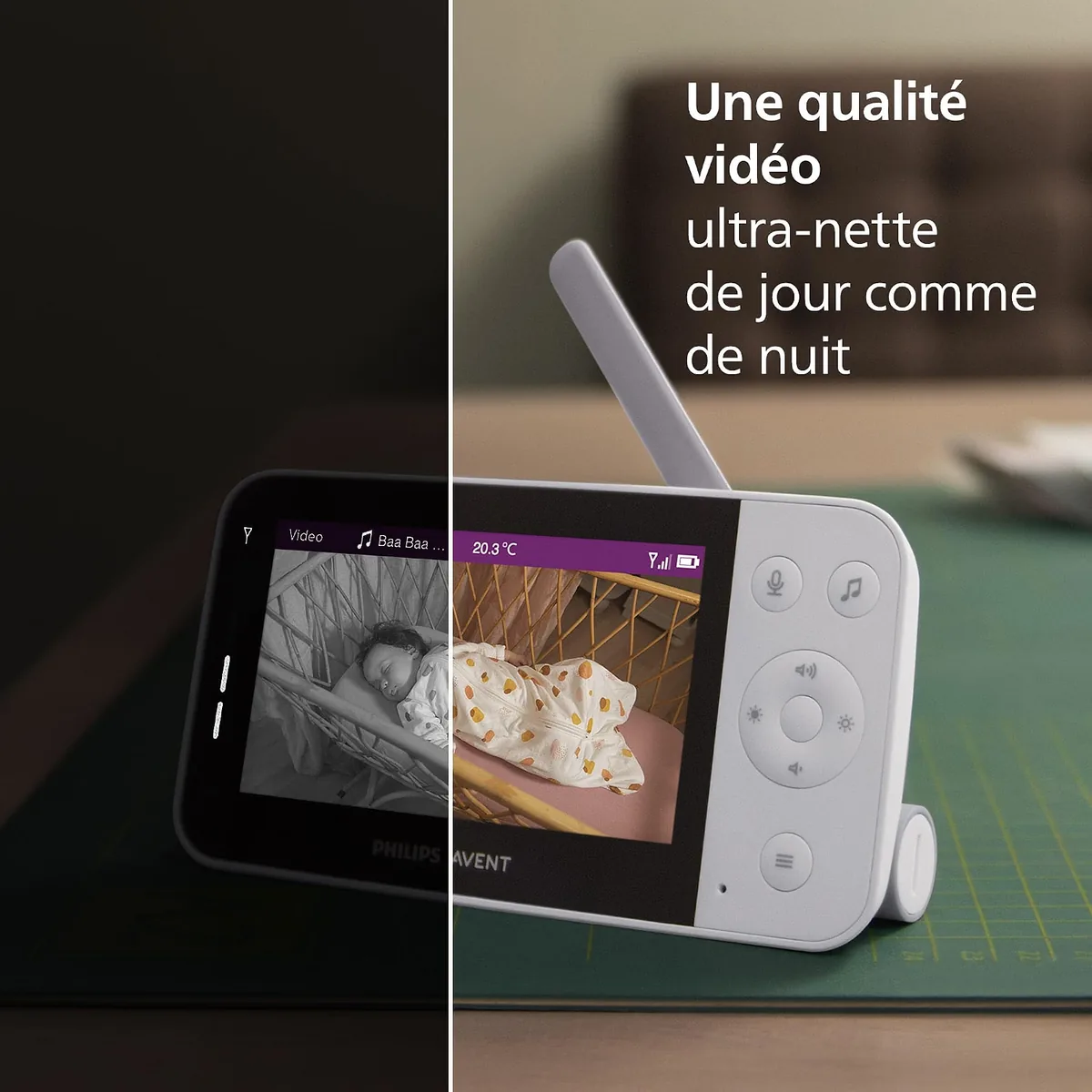
At night, the camera switches to infrared night vision: the picture turns black and white and stays readable in a dark room. Check that night vision switches on automatically, with nothing to do. A high resolution, such as the Full HD 1080p of the SCD951/26, helps you make out details, especially in the app. A digital zoom lets you frame your baby’s face from a camera placed away from the cot.
The field of view matters too. A wide-angle lens, such as the 120° stated by Philips, covers the whole cot from a wall or a chest of drawers. A motorised camera, which pans from the screen, lets you follow a child moving around a large bed or room; it is a convenience, not a necessity in a standard cot.
Criterion 6: the screen
A bigger screen is easier to read, but it lights up the parents’ room more and uses more battery. A 4 to 5-inch screen is a good compromise for a device you keep close to you. Look at the resolution too: the SCD951/26 screen shows 480 x 272 pixels on 4.3 inches, which is enough for monitoring but does not show all the camera’s detail. A good screen has adjustable brightness and switches off when nothing is happening, then comes back on at the slightest sound.
If you mainly plan to watch your baby on your phone, the quality of the dedicated screen matters less. If, on the other hand, you do not want to use the app, the screen becomes your only window on the room: give it more weight in your choice.
Criterion 7: sound and alerts
A good baby monitor transmits clear sound, without crackling, and has an adjustable microphone sensitivity. Too sensitive and it lights up at the slightest sigh; not sensitive enough and it misses quiet crying. Check for visual alerts, useful if you turn the volume down, and above all a connection lost alert, which warns you when you are no longer receiving anything.
Two-way talk lets you reassure your baby with your voice without going into the room. On some models you have to press a button to talk, like a walkie-talkie; on others, such as the SCD951/26 with its “Talk back” function, you talk and listen at the same time. Both work; the second feels more natural.
Criterion 8: data security
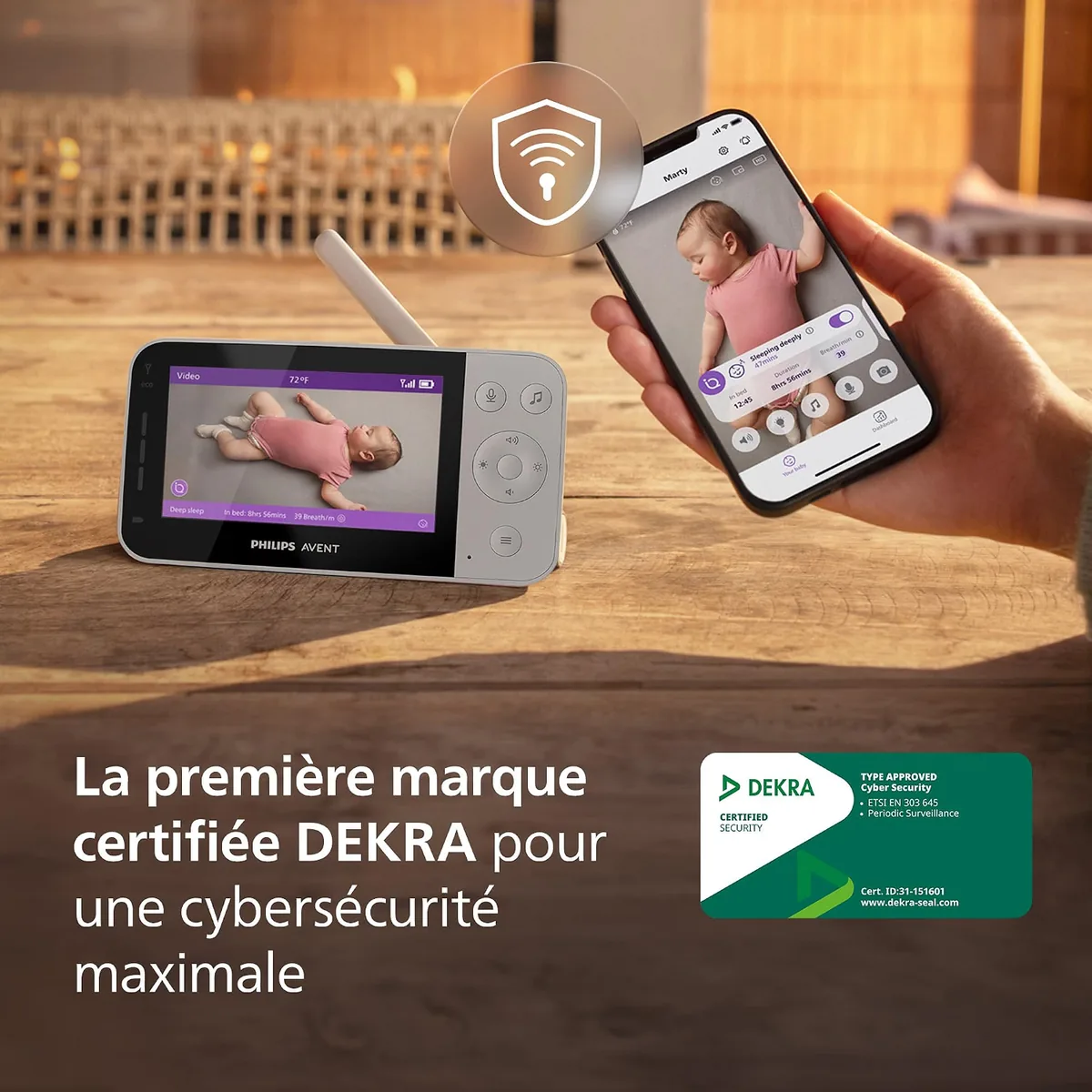
As soon as a baby monitor connects to the internet, security becomes a buying criterion. In 2022, the Belgian consumer association Test-Achats found 55 potential security flaws, nine of them critical, across ten video baby monitors tested, noting that the big brands did better. Before buying, look at what the manufacturer says about encryption, account management, updates and storage of images.
Philips, for example, presents its Secure Connect system as several encrypted links, and states that it does not store audio and video on its servers. The French data protection authority (CNIL) advises, for any connected device, changing the default settings, protecting your phone and Wi-Fi with a password and installing security updates. Be wary of very cheap cameras with no identifiable brand, no update policy and no clear information about data. Our article on baby monitor hacking details the right habits.
Criterion 9: set-up away from the cot
This is a safety criterion, and it should weigh in your choice. The US Consumer Product Safety Commission asks parents to keep baby monitors and cords at least three feet, about one metre, from any part of the cot, after several infant deaths by strangulation from a cable. So a baby monitor should also be chosen according to how it will be set up in your home: wall mounting possible, a cable long enough to reach a socket further away, a field of view wide enough to see the whole cot from more than one metre.
Before buying, find where the camera will go and the nearest socket. If the only socket in the room is right next to the cot, plan a solution, such as wall mounting on the other side of the room and a cable fixed to the wall. Our guide on setting up and adjusting a baby monitor goes through each step.
Criterion 10: soothing features
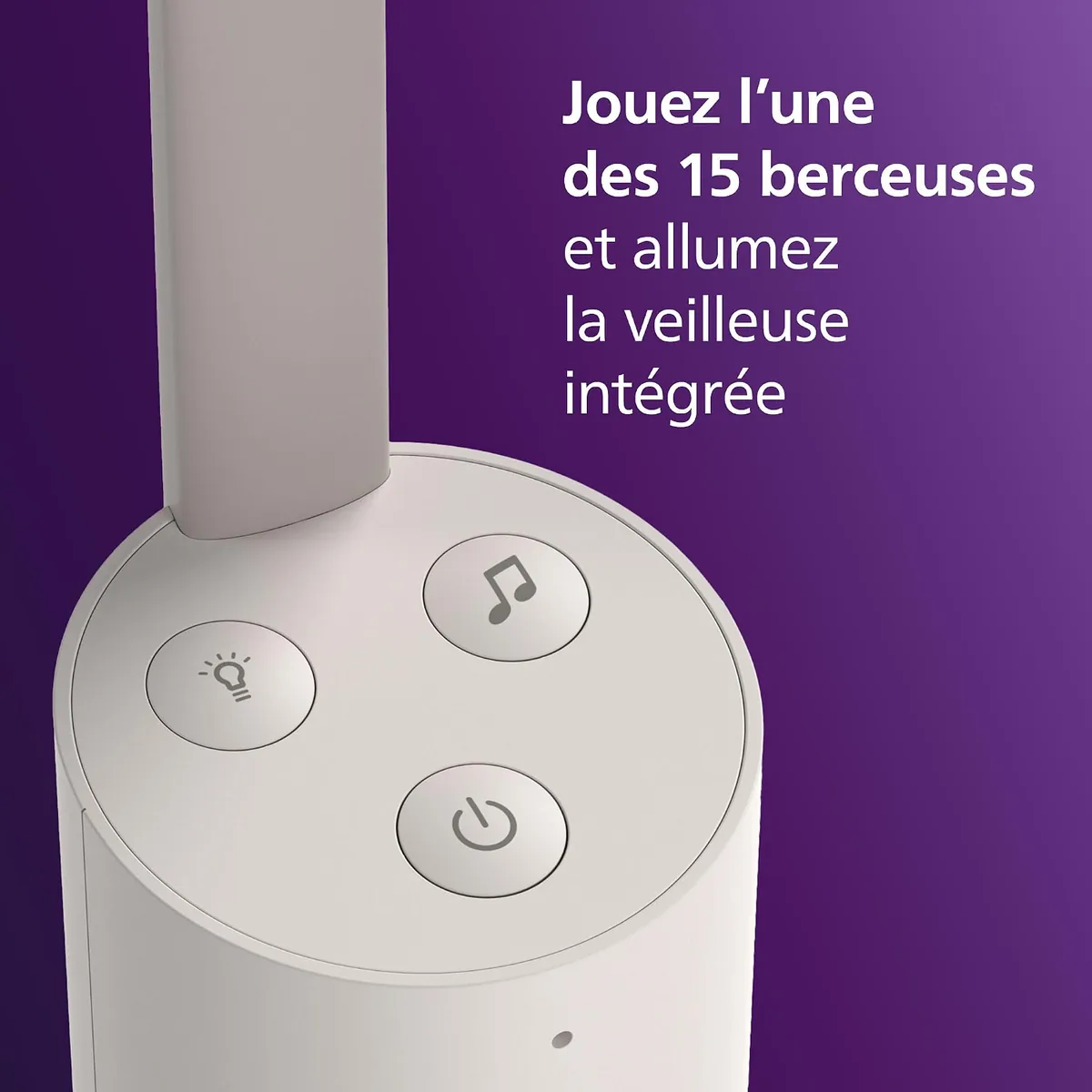
Night light, lullabies, white noise, personalised sounds: many baby monitors offer ways to help your baby fall asleep. These features are pleasant when they are easy to start and have a timer. The SCD951/26, for example, offers lullabies, soothing sounds and white noise with a timer, a night light with a timer and the option of recording your own sounds in the app.
Treat them as extras. A night light that is too bright can disturb sleep and the camera’s night vision; a sound playing all night is not necessary. The bedtime routine and a calm room at the right temperature matter more than the list of tunes.
Criterion 11: thermometer and sensors
A built-in room thermometer with an alert helps you keep the room between 18 and 20 °C, the range recommended by France’s public health agency, Santé publique France, and its “first 1,000 days” website. It is a useful extra, especially in winter and during heatwaves. Some models add a humidity sensor, motion detection or sleep statistics.
Be careful with promises of “breathing monitoring” or “safe sleep”. The American Academy of Pediatrics advises against relying on these devices to prevent sudden infant death. If your child has a particular medical need, it is up to the doctor to prescribe a suitable device.
Criterion 12: budget and length of use
Baby monitor prices vary a lot and change often: we do not display them. To compare, relate the price to how long you will really use the device. A baby monitor is often used for two to three years, sometimes longer, and can be used again for a second child. A reliable model, from a manufacturer that keeps providing updates, holds its value longer than a device that no longer receives security fixes.
Do not pay for features you will not use. If you will never watch your baby away from home, a direct-link video baby monitor without an app is enough. If your home is small and you do not miss the picture, an audio baby monitor will do. And keep some budget for the essentials of sleep: a compliant cot, a firm mattress and a sleeping bag in the right size.
Depending on your home
In a flat, range is rarely a problem. Go for simplicity, a good night picture and a pleasant screen. A direct-link model is often enough; the app becomes useful if your baby is looked after at home while you are out.
In a house on several floors, the link is the first criterion. Count the floors and walls, test as soon as the device arrives, and keep the option of using the app if a corner of the house is poorly covered. A battery-powered parent unit lets you move between floors.
With a garden, look at the stated outdoor range and the battery life. The 400 metres stated for the SCD951/26 are measured in open space: a thick front wall or a coated glass door can reduce it. Test from the far end of the garden.
In a shared or very connected home, many devices transmit on the 2.4 GHz band. The link may suffer; a test in several rooms will quickly tell you.
If your baby is looked after at home
When a grandparent, a nanny or a relative looks after your baby in your home, a baby monitor with an app lets you take a look during the nap without phoning. Talk about it openly with the person looking after your child: knowing that a camera is filming can make people uncomfortable, and trust matters more than surveillance. Say clearly when and why you will look, and respect their work.
In practical terms, choose a model that lets you share access properly, with a guest account you can remove later, rather than giving out your own password. Show the person looking after your baby how the parent unit works, where the camera is and why it must never be moved closer to the cot. Our article on watching your baby remotely covers these questions.
Where the baby monitor will live in your home
Before buying, picture the nursery and the rooms where you will be. Where will the camera go, more than one metre from the cot? Where is the socket? Will the cable have to cross a walkway? Will the camera see the whole cot from that spot, or will you need a wider lens? Facing a window, will the picture be dazzled in the morning?
Then think about your own bedroom. The parent unit sits on the bedside table, near a socket; its screen must not dazzle you at night. In the living room, it goes on a table or shelf, out of reach of older siblings and pets. In the garden, it needs to sit in the shade. These details seem minor; they are what makes a baby monitor pleasant to live with, or what makes you end up leaving it in a drawer.
When to buy it
There is no need to buy a baby monitor months in advance, but it is worth having it a few weeks before the birth. That gives you time to unpack it, check the contents, charge the parent unit, find the right spot for the camera and test the range around the house calmly, before the tiring first weeks. It also leaves time to return it within the cancellation period if it does not suit your home.
If your baby will sleep in your room for the first six months, as Santé publique France recommends, the baby monitor will first be used for daytime naps. You can therefore wait a little, as long as it is ready before your baby starts napping in another room. In any case, avoid setting it up in a hurry the evening before you need it: that is when the cable ends up too close to the cot.
The small extras worth planning
A few inexpensive items make set-up safer and everyday use easier. Adhesive cable clips or a cable channel keep the cable flat against the wall all the way to the socket, out of reach. A wall bracket, when the model allows it, places the camera up high and away from the cot. A spare USB phone charger lets you charge the parent unit on your bedside table, which matters for a model whose box contains only one power supply.
A simple tape measure is also useful: measure the distance between the camera, the cable and the cot once, rather than estimating it by eye. And if your home has a large garden or several floors, plan to test the range before choosing where you will spend nap times. None of these extras replaces the basic rules; they simply make them easier to follow every day.
The most common buying mistakes
- Choosing only on stated range, without counting the walls and floors in your home.
- Buying a Wi-Fi-only camera for the night, with no dedicated screen or reliable connection lost alert.
- Neglecting data security for a cheap model with no identifiable brand.
- Forgetting about set-up: no socket away from the cot, cable too short, no wall mounting.
- Paying for useless features, such as sleep tracking you do not need.
- Taking the stated battery life literally, without reading the measurement mode.
These mistakes have one thing in common: they start from the product listing rather than from your everyday life. By going back to the first question of this guide, the situations in which you will use the baby monitor, you avoid almost all of them.
Product listing traps
- “400 m range”: in open space, with no obstacles. Indoors, the range is much shorter.
- “12 hours of battery life”: often in power-saving mode, screen off. Read the note at the bottom of the listing.
- “Secure connection”: a manufacturer’s statement. Find out what it covers: encryption, account, updates.
- “Peaceful sleep”, “detects everything”: a baby monitor does not protect against sudden infant death.
- Photos of a camera placed on the cot: they show a dangerous set-up. The camera goes more than one metre away.
- Similar model numbers: the same trade name can cover several versions with different box contents.
Buying second-hand
A second-hand baby monitor can be a good deal. For a direct-link model, check that it is complete, with both units, the power supplies and the instructions, that the screen and sound work, and that the battery holds its charge. For a connected model, ask the seller to remove the device from their account, reset it as described in the instructions, then create your own account with a new password. Finally, check that the manufacturer still offers the app and its updates: a connected device abandoned by its manufacturer is no longer a good choice.
When others buy it for you
A baby monitor often appears on baby shower lists, and you may be given one or lent one. That is handy, with one catch: the person giving it often chooses from a photo and a price, without knowing your home. For the gift to really suit you, give a precise model number, or at least the criteria that matter to you: direct link or Wi-Fi, range, battery life, night picture.
For a baby monitor lent by family or friends, run the same checks as for a second-hand purchase, and for a connected model, make sure it has been removed from the previous owner’s account. And if you receive two baby monitors, keep the one that best suits your home and exchange the other for something useful, such as a sleeping bag in the right size.
Test before you keep it
As soon as it arrives, run a full test before the first night. Install the camera in its final spot, more than one metre from the cot. Walk around the house with the parent unit while someone else talks softly near the camera. Switch off the light to check the night picture. Unplug the router for a few minutes to see what the baby monitor does. Test the app on mobile data if you plan to use it. If something does not suit you, you are still within the cancellation period for an online purchase. Our calculator helps you prepare this test.
The checklist before you buy
- I know whether I want the picture, or whether sound is enough.
- I know whether I will watch my baby away from home.
- The baby monitor works if the router goes down.
- I have counted the walls and floors between the nursery and my living areas.
- The stated battery life specifies its measurement mode.
- Night vision is automatic and the field of view covers the whole cot.
- There is a connection lost alert.
- The manufacturer describes encryption, the account and updates.
- I can set up the camera and its cable more than one metre from the cot.
- I have checked the exact model number, the seller and the box contents.
The Philips Avent SCD951/26 against these criteria
| Criterion | Philips Avent SCD951/26 |
|---|---|
| Audio or video | Video, with audio-only mode |
| Link | Direct (peer-to-peer) and Wi-Fi, 2.4 GHz band |
| Stated range | Up to 50 m indoors, 400 m outdoors |
| Battery life | 12 h in Eco mode after a full charge |
| Picture | Full HD 1080p, automatic night vision, zoom, 120° lens |
| Screen | 4.3 inches, 480 x 272 |
| Sound | Talk back, sound, motion and connection lost alerts |
| Data | Secure Connect, audio and video not stored on servers according to Philips |
| Installation | Wall mounting possible, baby unit on mains power |
| Soothing | Lullabies, sounds, white noise, night light, timer |
| Sensors | Room thermometer with alert |
The SCD951/26 ticks most of the boxes for an everyday video baby monitor. Its weak points are the price, the manual camera angle and the screen resolution. Our detailed review covers each point.
Frequently asked questions
What is the most important criterion?
How reliable the link is in your home, then being able to set up the camera more than one metre from the cot. Everything else comes after.
Do you need a baby monitor with an app?
Only if you want to watch your baby away from home. Otherwise, a direct-link model is enough.
Is an audio baby monitor enough?
In a small home, often yes. Video mainly helps you decide whether to get up at night.
Are stated ranges reliable?
They are maximums in open space. Test at home as soon as it arrives.
Is a cheap baby monitor risky?
Not necessarily for an audio or direct-link model. For a connected camera, data security and ongoing updates matter a lot.
Articles in this section
An eye on your baby, anywhere.
Full HD camera · Night vision · With or without Wi-Fi · Talk back · 12 h in Eco mode. The price changes often on Amazon: check it, along with the seller, the exact model number (SCD951/26) and what is in the box, before you order.
Check the price on AmazonAffiliate link · new tab