Baby monitor: from when, and until when?
There is no official age to start or stop using a baby monitor. There are mainly stages, and rules that change as your child grows. Here is how to find your way, from birth to the first years.
Contents
The short answer
A baby monitor can be used from the day you come home from hospital, mainly for daytime naps and evenings. For at least the first six months, France’s public health agency, Santé publique France, recommends putting your baby’s cot in the parents’ room at night: the baby monitor is then less useful. It really comes into its own when your child moves into their own room, and many families keep it until two or three years old, sometimes longer. There is no official age to stop: you put the baby monitor away when it is no longer useful, or when your child grows to the point of wanting some privacy.
One rule runs through all these stages, and it becomes even more important as your child grows: the camera and its cable stay more than one metre from any part of the cot, out of reach of a child standing up.
From birth: what for?
In the first weeks, your baby sleeps a lot, often during the day, while you are in another room. The baby monitor lets them sleep quietly in their cot, flat on their back, while you prepare a meal, rest in the living room or have visitors. Video reassures parents in the first weeks: a glance at the screen tells you whether your baby is sleeping peacefully or starting to stir.
Keep the device’s limits in mind. The American Academy of Pediatrics points out that monitors sold to the general public should not be used as a strategy to prevent sudden infant death. Prevention comes through how your baby sleeps: on their back, on a flat surface, in their own cot, with no pillow, blanket, cot bumper or soft toy, in a sleeping bag of the right size.
The first six months: sharing the room
Santé publique France, on its “first 1,000 days” website, advises putting your baby’s cot in the same room as the parents for at least the first six months, for their safety. At night, you are therefore next to them, and the baby monitor is not needed to hear them. It remains useful in the evening, when your baby goes to bed before you and you are in the living room, and for daytime naps.
If you use it in the parents’ room, for naps or in the evening for example, the set-up rule stays the same: the camera and its cable more than one metre from your baby’s cot. And remember to switch off or dim the parent unit’s screen at night so that it does not dazzle you.
Moving into their own room
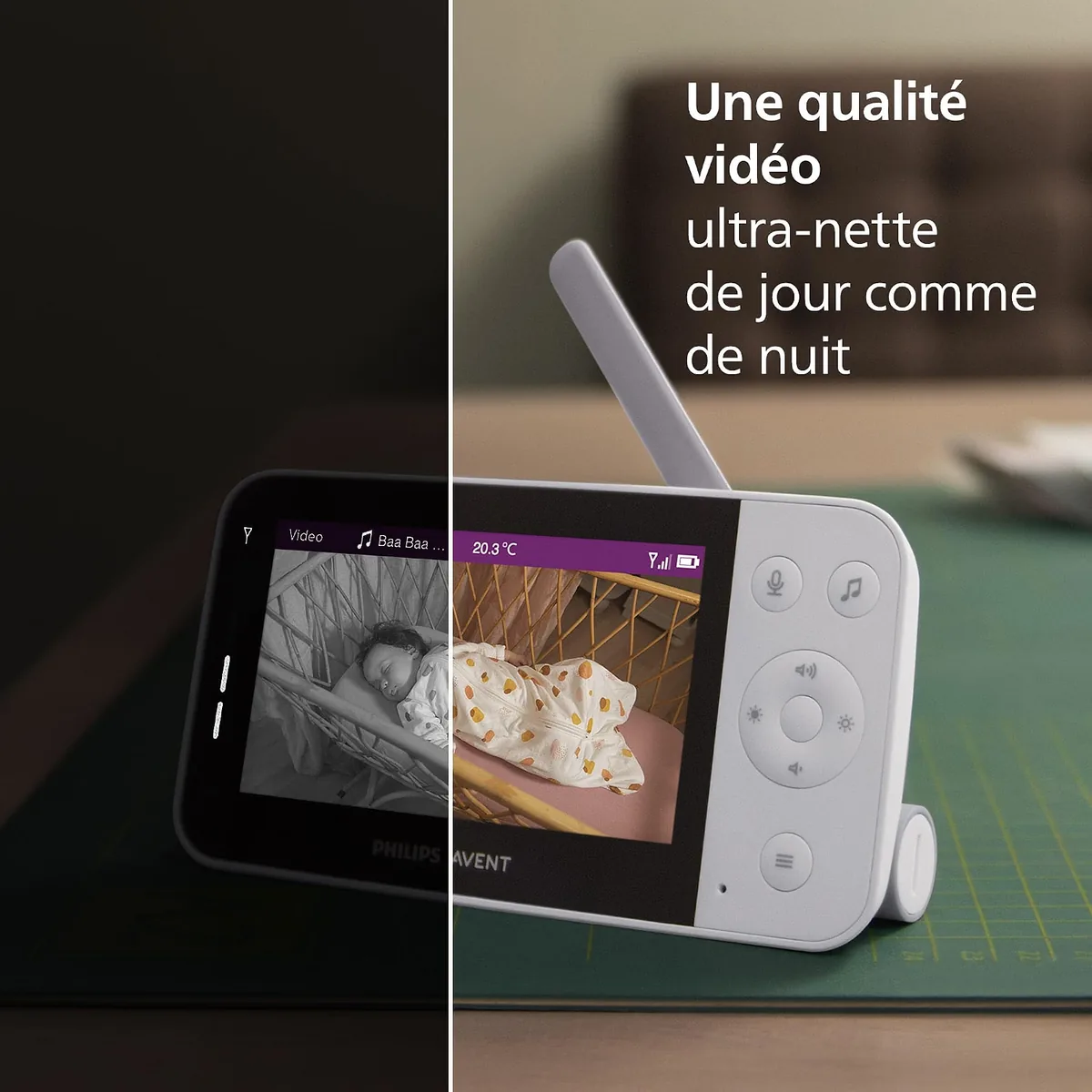
When your baby moves into their own room, the baby monitor becomes the main link between you at night. This is the time to check the set-up: camera fixed to the wall or placed on furniture some distance away, cable fixed along the wall, lens framing the whole cot, night vision switching on properly. Test the range from your bedroom, door closed, and check that the connection lost alert works.
Also get into the habit of plugging the parent unit in at night. A battery that runs down at 4 a.m. would leave you without alerts at the worst moment. Our guide on setting up and adjusting a baby monitor goes through each step.
When your child stands up
Towards the end of the first year, many children start standing up in their cot. This is the stage when the risk from cables increases: a child standing up grabs whatever is within arm’s reach, pulls and puts things in their mouth. The US Consumer Product Safety Commission reports deaths and near-strangulations of children several months old, including a 20-month-old found with a camera cord around his neck.
Check the set-up again at this point. Measure the distance between the edge of the cot and the camera, and between the edge of the cot and the cable along its whole length. Think about what your child can reach by leaning over the bars. If the camera is on a chest of drawers, check that they cannot reach it or pull the cable. Wall mounting up high often remains the safest solution.
The toddler in the cot
Between one and three years old, the baby monitor is used differently. Your child sleeps through the night more often, but still has wakings, nightmares, teething nights or colds. Video lets you see whether they settle back to sleep on their own or need you, without going in and waking them fully. The talk function sometimes lets you reassure them with your voice.
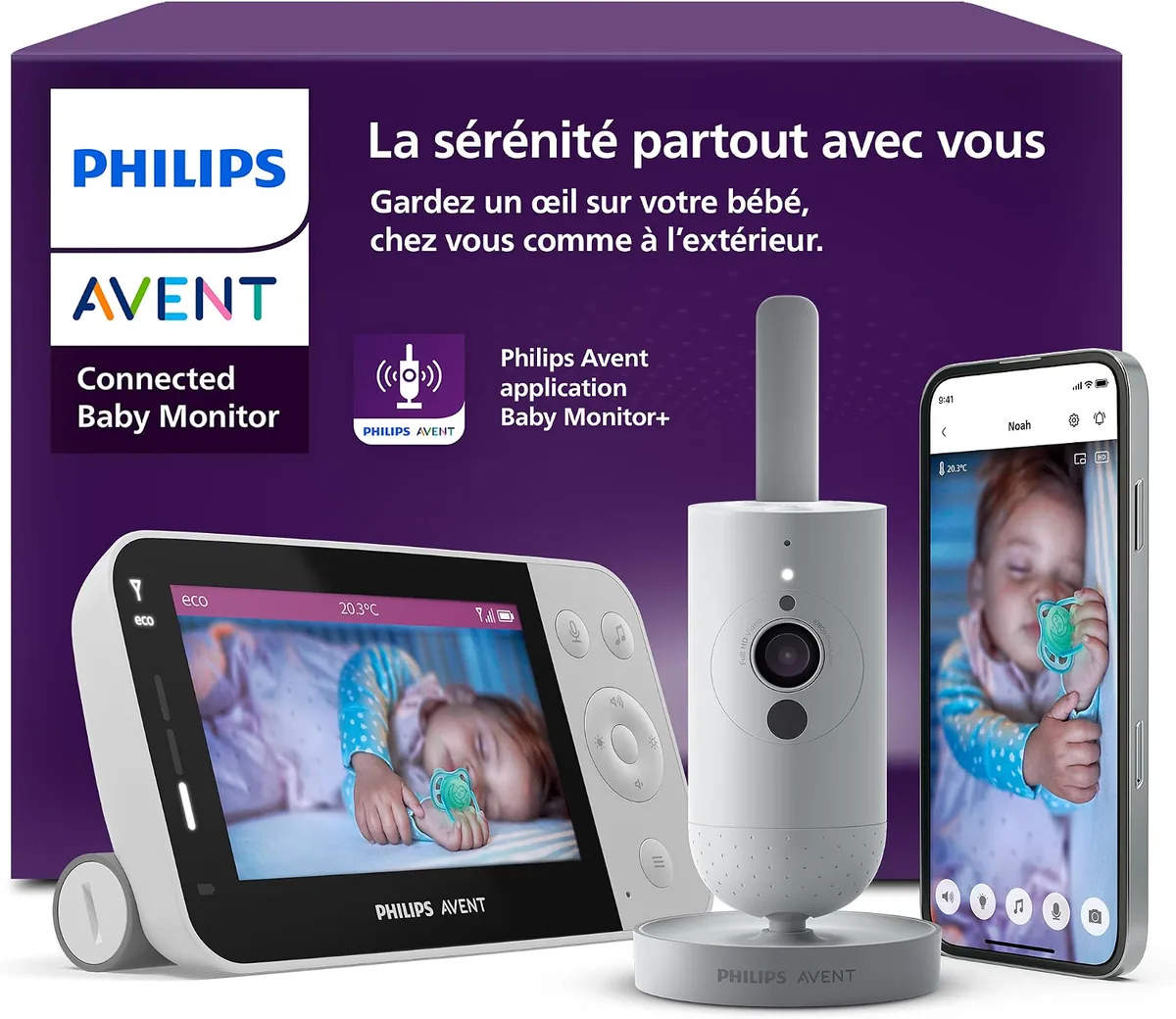
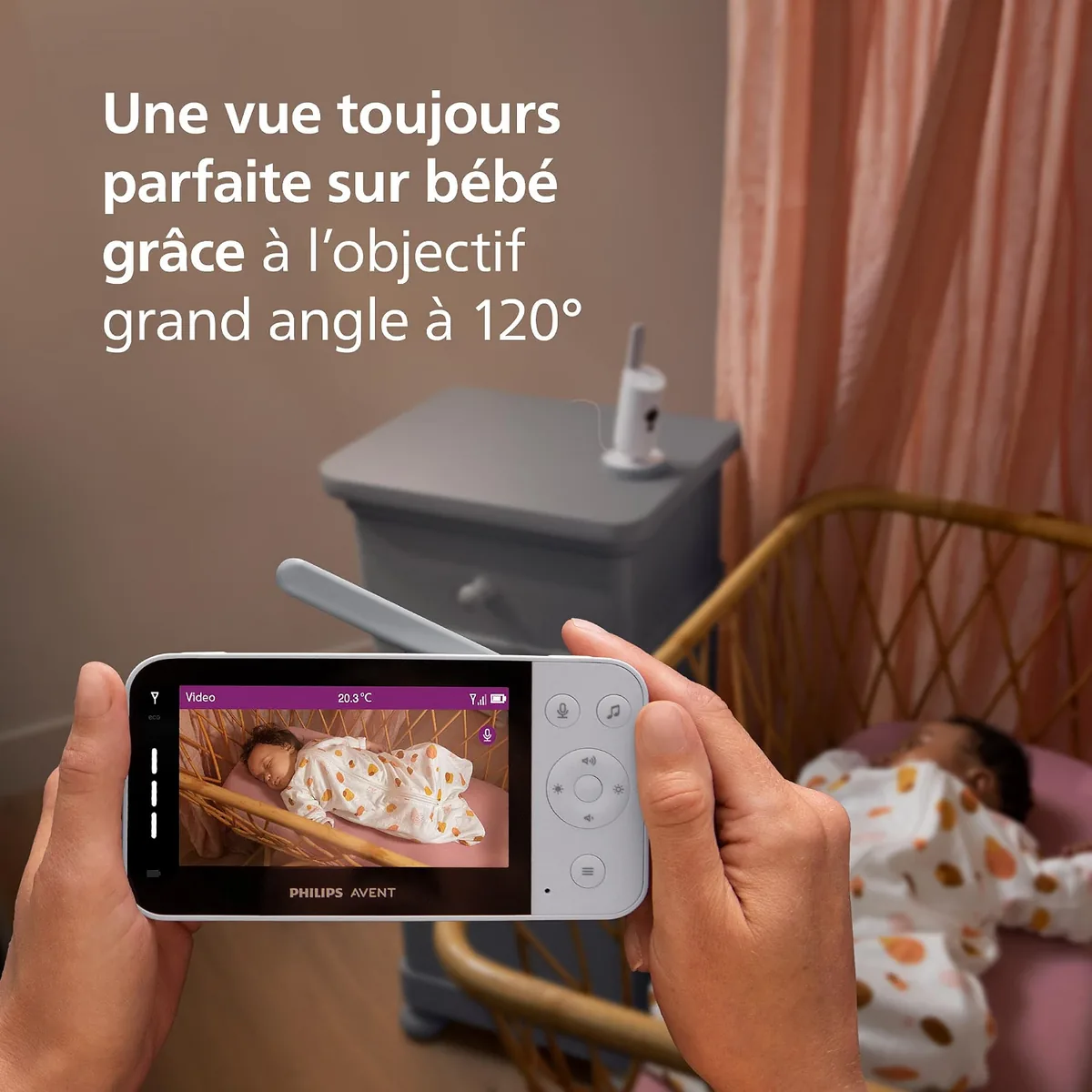
This is also the age when they move around a lot in the cot. A wide-angle lens, such as the 120° stated by Philips for the SCD951/26, helps keep the whole cot in frame. A motorised camera is an added convenience in a large room, not a necessity.
Moving to a big bed
When your child moves to a bed without bars, they can get up, walk around the room and reach things that were out of reach from the cot. Go round the room again at their height: the camera, its cable, the socket and the night light must stay out of reach. A camera mounted high on the wall, with the cable in a channel, is the safest set-up at this age.
The baby monitor can then be used to check that they do not get up at night, or put themselves in danger by climbing. A child who understands what a camera is may also try to touch it: explain what it is for, and keep it out of reach.
Nights of illness
Even after putting the baby monitor away, many parents bring it out again for a night of fever, a stomach bug or a cough. This is a sensible use: it lets you hear a cough getting worse or a child being sick in bed. So keep it stored with its instructions and cables, rather than getting rid of it too soon.
A baby monitor does not replace your attention. If your child shows worrying signs, such as difficulty breathing, unusual drowsiness or a high temperature in a young baby, call your doctor or the emergency services (112 across Europe, 999 in the UK). A baby monitor is not a medical device.
The baby monitor in the bedtime routine
A baby monitor works best when it becomes part of the bedtime routine rather than an afterthought. In practice, the same few gestures every evening are enough: check that the cot is clear, put your baby down on their back in a sleeping bag, glance at the room temperature, then switch on the camera and check on the parent unit that the picture and sound come through before leaving the room. Take the parent unit with you, and plug it in once you are in your own room.
As your child grows, the routine changes a little. A toddler may want to say good night to the camera, or ask about the little light on the baby unit. Keep it simple and honest: it is there so that you can hear them if they need you. Avoid using the talk function to replace your presence at bedtime; a quiet voice through the speaker can help with a light waking, but a story and a cuddle remain the heart of the routine. And when you start thinking about putting the baby monitor away, the routine is a good place to begin: switch to audio-only mode for a few weeks, then stop altogether.
Signs it is time to put it away
- your child sleeps in a room close to yours, and you can hear them without a device;
- they sleep through the night and come to find you when they wake;
- they ask for the camera to be switched off, or hide to get dressed;
- you never look at the screen any more, and the baby monitor only reassures you out of habit.
There is no right or wrong age: some families put the baby monitor away at one year old, others keep it at four in a large house. What matters is that it meets a real need, and that the set-up remains safe.
Privacy for a growing child
A three or four-year-old understands what a camera is and may not like being filmed. This is a good time to talk about it with them: what the baby monitor is for, when it is on, who is watching. Some parents switch to audio-only mode at this age, which keeps the sound alert without filming the child. The SCD951/26 offers this mode, according to Philips.
If the app is activated, review access too: who can still watch the camera remotely? Has an old access given to a childminder or a grandparent been removed? The French data protection authority (CNIL) stresses the importance of regularly checking the settings of connected devices.
With a second child
A well-maintained baby monitor is often used for several children. Before bringing it out again, check its condition: cables intact, parent unit battery holding its charge, clear picture and sound. For a connected model, update the app and the baby monitor, and check the list of people who have access to the camera. Find the instructions or download them from the manufacturer’s website.
If the two children sleep in different rooms, you need either two cameras or to choose which child to monitor. Some models accept several cameras on the same screen; check compatibility in the instructions before buying an extra camera.
At the childminder’s or the grandparents’
When your child sleeps elsewhere, at a childminder’s or at the grandparents’, the baby monitor can travel with them, as long as the set-up there follows the same rules. In a spare room, the socket is sometimes right next to the travel cot: bring an extension lead that you can run well away from the cot, or rearrange the furniture. Explain the one-metre rule to the person looking after your child, and show them how the parent unit works.
A direct-link model that comes paired can be set up again elsewhere in a few minutes, with no configuration. That is a practical advantage of baby monitors with a dedicated screen over Wi-Fi cameras, which need to connect to the host home’s network.
Summary table
| Stage | How the baby monitor is used | What to watch out for |
|---|---|---|
| Birth to 6 months | Naps and evenings; at night, your baby sleeps in the parents’ room | Safe sleep, camera more than one metre away |
| Moving into their own room | Night-time monitoring | Range, connection lost alert, parent unit plugged in |
| Child standing up | Night-time monitoring | Cable out of reach of a standing child |
| 1 to 3 years | Wakings, nightmares, illness | Whole cot in frame, voice to reassure |
| Big bed | Checking for night-time wandering | Camera and cable out of reach anywhere in the room |
| Afterwards | Nights of illness | Child’s privacy, remote access to review |
Common mistakes
- Thinking that a baby monitor makes it safe to move your baby into their own room earlier.
- Not checking the set-up again when your child stands up.
- Leaving a cable hanging behind the cot “because they have never grabbed it”.
- Forgetting to remove remote access given to former carers.
- Filming an older child without explaining what the camera is for.
Signs it is time to stop
- You have not looked at the screen for several nights, and nothing was missed.
- Your child calls you, gets up and comes to find you when they need you.
- They sleep regularly, without frequent night wakings.
- They notice the camera and ask for it to be taken away.
- You can hear them without a device from your bedroom.
There is no need to stop all at once: switching to audio-only mode for a few weeks is a good transition before putting the baby monitor away.
What to do with the baby monitor afterwards
Once put away, the baby monitor can be used again for a second child. Store it complete, with its adapter, cables and instructions, somewhere dry. Charge the parent unit from time to time if you plan to reuse it, to preserve the battery. If it is a connected model you will not reuse, delete it from your account, remove shared access and reset it before giving it away or selling it, as explained in our article on baby monitor hacking.
Some parents also keep the baby unit as a simple night light or for its lullabies once monitoring is over. In that case, the one-metre rule and the cable tidying still apply as long as the device is in the room.
Every family moves at its own pace: there is no official age to put the baby monitor away. Go by your nights, your child’s independence and your own peace of mind, always keeping a safe set-up as the priority.
Frequently asked questions
Can you use a baby monitor from birth?
Yes, for naps and evenings. At night, Santé publique France recommends that your baby sleeps in the parents’ room for at least six months.
Up to what age should you keep a baby monitor?
There is no official age. Many families keep it until two or three years old, and bring it out again for nights of illness.
Should anything change when your child stands up?
Yes: check again that the camera and the whole cable are out of reach of a standing child, more than one metre from the cot.
Is audio-only mode suitable for older children?
It is a good option for respecting a growing child’s privacy while keeping the sound alert.
An eye on your baby, anywhere.
Full HD camera · Night vision · With or without Wi-Fi · Talk back · 12 h in Eco mode. The price changes often on Amazon: check it, along with the seller, the exact model number (SCD951/26) and what is in the box, before you order.
Check the price on AmazonAffiliate link · new tab